
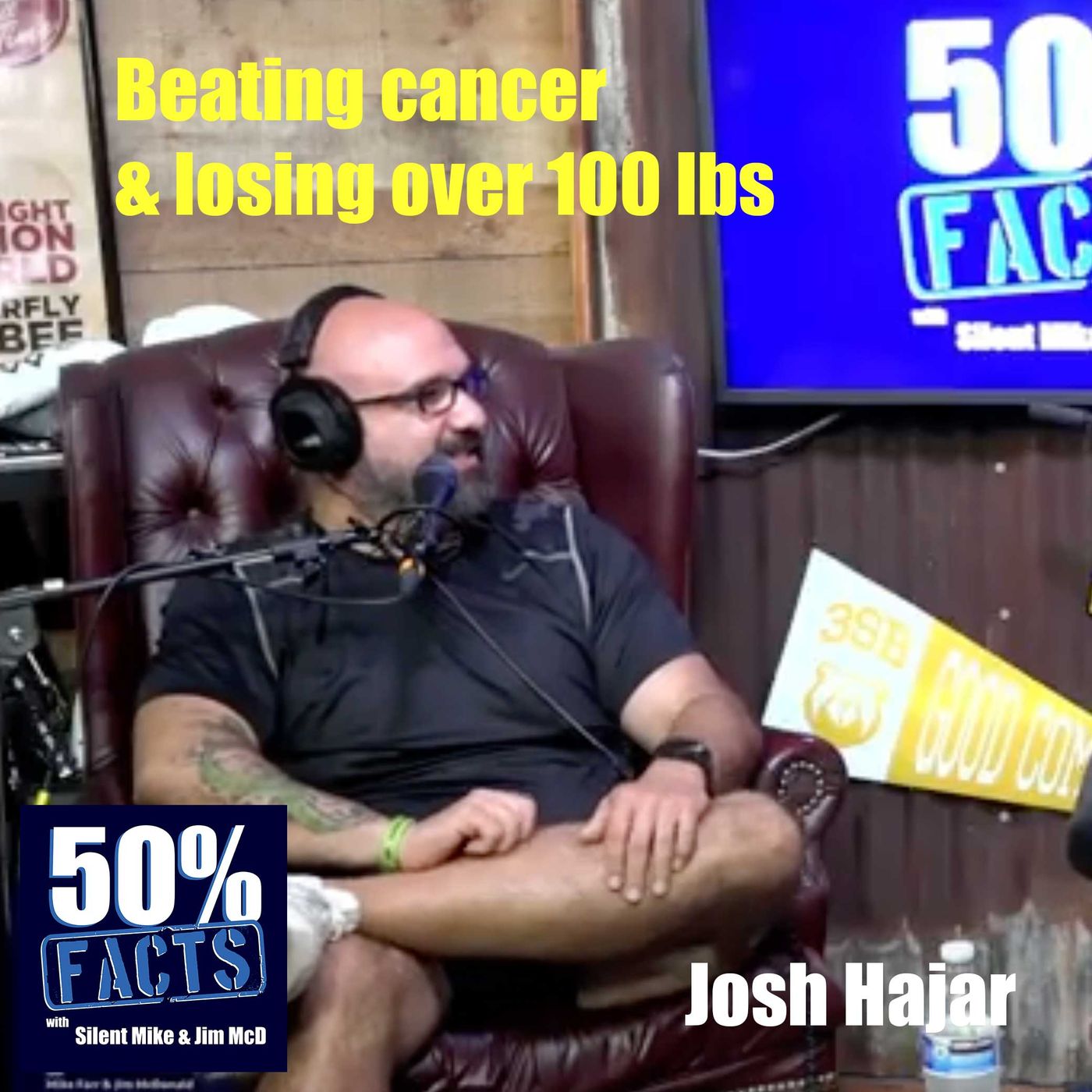
Josh Hajar: Staying positive, beating cancer, and losing over 100 lbs

 Apple Podcasts
 Spotify
 Goodpods
 Audible
 iHeartRadio
 Podchaser
 RSS Feed
 Castro
 Mike is out of town, so Jim brought in one of Third Street Barbell’s most consistent and inspirational members, Josh Hajar.
Josh is an emergency department nurse who faced a harrowing fight with non-Hodgkin’s Lymphoma, and then suffered an injury that set back his recovery and fitness goals. When he arrived at Third Street, he was finally ready to execute a winning game plan for losing weight and getting stronger. Building on the advice he received when he first received his cancer diagnosis to “Be Positive,” Josh sets a strong example in and out of the gym.
Join our Discord for free at goodcompanydiscord.com!
Check out our gym (Third Street Barbell) at ThirdStreetBarbell.com https://www.thirdstreetbarbell.com/ and subscribe for updates about our apparel line at goodcompanyapparel.com https://3sb.co/! Local memberships and international fresh fits! Get early access to our NEXT DROP!
Check out our podcast website: 50percentfacts.com https://www.50percentfacts.com/
50% Facts is a Spreaker Prime podcast on OCN – the Obscure Celebrity Network.
____
Hosted by Mike Farr (@silentmikke) https://www.instagram.com/silentmikke/ and Jim McDonald (@thejimmcd). https://www.instagram.com/thejimmcd/
Produced by Jim McDonald
Production assistance by Sam McDonald and Sebastian Brambila.
Theme by Aaron Moore. Show art by Joseph Manzo (@jmanzo523)
Become a supporter of this podcast: https://www.spreaker.com/podcast/50-facts-with-silent-mike-jim-mcd--5538735/support .
0:10 Okay, so Mike is as a popular broadcast I like to listen to, likes to say on assignment. He's he's working on something else right now, so he's not not available to me for podcasts. So I'm going to have a string of guest slash co hosts, I guess for the next few weeks. I have not done a any kind of a show without Mike since late twenty eighteen. So you know, if I if I go up at some point, just kind of poke me and then I'll try to The standards are high, though, oh I said the standards are high. Standards are high.
0:55 Yeah, absolutely. I'm here with josh one of our members. I'm going to have you introduce yourself. We don't stand on ceremony here. Actually we hardly ever stand for anything as lazy. But anyway, Hi, my name is Joshua jar I am forty two years old, turning forty three soon. I've been working out at Third Street Barbell since April of twenty twenty three. Okay, I was not sure exactly how long it about it. I knew it'd been a while, but yeah, yeah, we're gonna tilt that Mike just a little bit more towards your mouth, just like out out out. Yeah, there we go. There we go. Okay, that's probably that's a little better. Yeah, yeah, yeah, it's just I can tell you're you're kind of falling off Mike. So now all right, not Mike, not you know what I mean.
1:43 Yes, So. I want to talk to you just because I know you have you have an interesting story, definitely faced some some struggles, some some battle some things like that, and you can feel free at any point to say, oh that's not a direction I want. To go whatever. Yeah, not a problem, thank you. Well, you know we can cut that on. We can do whatever. So you are you were nurse? Yes, I'm an emergency nurse. I've been an emergency nursing in some capacity in about fifteen years. I started working in healthcare in the early two thousands. I worked kind of like the desk to start, and then I've been in various roles until I became a nurse. I worked as nursing administration for a small portion of my career, but mostly with emergency patients in the emergency department.
2:41 Okay, cool, And what was the like a lure of nursing And I know what kind of person you are, so I know the answer to the question, but I'm gonna ask it anyway. Initially I took the job as working the front desk of an emergency department because I needed money for college. And then I started really liking the aspect of healthcare, the teamwork that I saw from my coworkers, and so one of them kind of encouraged me to look at becoming an EMT, which I did, and then becoming a nurse, which was the ultimate goal. So that was the allure of it was I saw how well we all worked as a team, even when I just worked at the desk and I wasn't physically at the bedside with patients.
3:25 And then as my career progressed and I started more hands on with patients, it was really enjoying the teamwork aspect and having colleagues that were, you know, we had to function as a team or we really couldn't perform our duties. Nursing has been historically been a profession that is dominated by the sheer number of women who do it, and men have definitely been more in the minority. I think that's grown over the last probably twenty twenty five years. My wife was a nurse and so and you know that, and I've definitely seen over the years that she was working with more men as nurses. Is there was there any push back in your head about that.
4:14 Or there was never really any pushback in my head about it when I saw what nurses did, especially in the early two thousands. It's a lot different from what those stereotypes originally were, And I think as a profession we've done a really good job at getting rid of some of those stereotypes. We work in an environment that you know, from the emergency department to any capacity that you work with patients directly in the q care setting where it's high stress. You have to use a skill base that's physical. You have to use a knowledge base not just from your training in school, but what you learn on the job. So I think that the society as a whole is starting to respect the profession more.
4:56 They're not just seen as caretakers who clean people up after they've soiled themselves, but they see them as people who administer high risk medications and they need to know all the parameters around those and that we are directly responsible for saving the lives of people. Doctors do a great job don't get me wrong, but they spend maybe five to ten minutes with every patient, and then it's response to the nurse's responsibility for telling the doctor. I see these labs, I see these vital signs, I see these symptoms. Can I get orders to intervene with this? And I think society as a whole is starting to see us more in that light. I think that nursing has become and this is just from observation, more technical over time, Yes, definitely, and that and you know a lot of guys are drawn to that part of it, and that's why I like it.
5:46 There's a lot of a lot of guys become a MTS or paramedics or whatever because that's a very technical and you know, kind of algorithmic almost. These are the things, these are your standing orders. You can do these things, and these are your standing orders. These are the things that I'm capable of with the physical skills, IVY placement, all those things that I have to do that. You know, if you ask the doctor to place an IV unless they were trained in certain regions or in the military, they wouldn't. Know how, they wouldn't know how to do it. Yeah, So there's there's certain things that I'm really good at. I am the IVY guy at my facility, and I really enjoy that. I really enjoy that resource. But there's also there. It's it's it's the knowledge that comes with the technical skills too. You know how to use the algorithms what you're talking about to intervene when somebody's having a life threatening situation. And that's like you get to use that knowledge on a day and day out basis.
6:41 Let me ask you this question. When you see bodybuilders, like pictures of bodybuilders or just the bodybuilders out in the wild, are you surveying their veins? Sometimes? I am. Sometimes you see somebody and you're just like, oh my gosh, those are amazing veins. And I think that's just a part of the business. We see it all the time. Yeah, it's and yeah, phlebotomous and nurses are always like, oh, you have good veins. Yeah, that's like one of the first things you noticed. Now that if you've been in the trade long enough, Yeah. I'll tell you that my anti cubital is run transverse and so and that freaks and put some of them out. They don't know like how to how do I go into that. It's like just it's a vein, just goes to the sideways to tilt the angle, tilt the angle.
7:25 You'll get it, trust me. Just don't what And I mean I'm not huge veins currently, but I they they're not hard to find. No, No, I'm always frustrated when somebody misses and it's so like I could stick myself. Why are you doing? It's a I would say it's a nerve wracking thing when you first start, and sometimes you'll just end up missing because they they they most trades. When it comes to phlebotomy to nursing, we are not allowed to practice on humans. So when we first come out or when we're still in school, that's when we get and we're kind of working more on the inside of our schooling or our training. We sometimes we do get to work on humans, but in a lot of states, we can't stick ivs or any needles inside of a human until we get our first job. So you might be running into people who maybe they've only got a couple months experience to less than a year's experience.
8:18 Yeah, when I was sixteen, I ended up in the er for something stupid and not something well so was something stupid I did, but it was just anyway, there's we don't need to get into exactly why I was there anyway. Had a nurse, probably considering where I was, probably in LVN, tried to draw blood and she literally went all the way through the vein and scraped the bone. Oh that's painful. It was the biggest bruise I've ever had on my arm at any point in my life. It was it was a whole thing. Yeah, that sounds really painful. It was. It was not good at all. I was frustrated by that. I know that another part of your journey is having been diagnosed with a life threatening illness, and like, first before we launched into what it was, what did that feel like as a medical professional?
9:21 Oh, so this is this is this actually kind of relates to nursing a little bit too. My story, and it's kind of an aspect of my story. I don't tell that often. So in February of twenty nineteen, before I was diagnosed, I was involved with a pediatric fatality at work that kind of left me with some symptoms of CPTSD and I kind of knew this was happening, and this is February of twenty nineteen. So I was having difficulty sleeping, I was having anxiety, I was having palpitations, I was having night terrors, like all all the symptoms you get from PTSD, right, And then in March of twenty nineteen, those symptoms progressed and kept getting worse. Palpitations, occasional shortness of breath, chest tightness, all these things, And so I kept thinking to myself, Oh, this is just the symptoms of my PTSD. I'm okay, you know, I just need to find ways to calm my anxiety and I'll feel better. But the anxiety and the symptoms of shortness of breath, chest pressure and just palpitations kept getting worse.
10:25 I was wearing like a garment fitness watch at the time, and it was telling me that my resting heart rate was in the one thirties, and I was like, oh, this can't be anxiety. This is way too high. But I didn't know what was going on, and I didn't start feeling severely short of breath until April of twenty nineteen. At that point in time, I was working for a facility that had an urgent care kind of attached to the emergency department. So I said, after my shift, I'm going to go and just check into the urgent care and say, I'm feeling a little shorter breath. Can you check me out. The doctor there Ransom lab work in an EKG and did a chest X ray and at that point in time you could see the mass in my chest. But I was thirty seven years old then, and he thought it was just anxiety and said, just follow up with your doctor. And so here I'm thinking, okay, I got checked out by a doctor. It's an emergency room doctor. I'm fine, it's just me. It's just anxiety from this event that I went through. All these things by Memorial Day actually just passed. By Memorial Day of twenty nineteen, I was severely short of breath. My resting heart rate was in the one fifties. I was pale.
11:34 I went into work and my coworker said, you look like you are dying, and I said, I feel like I'm dying. And I was working an administrative role at that point in time. Sorry, I was working administrative role at that point in time. And my boss and one of the doctors that I worked with, said, we're going to bring you to the er. Now. They brought me to the emergency department and I kind of gave a story about I've been feeling progressively more short of breath than palpitations, and they saw that my heart rate on the monitor was very fast, and they said, oh, we think this might be a blood clot in your lungs called a pulmonary embolism, because you've been driving long periods of time to move from where you've lived to here to Sacramento. And I said, okay, let's check it out.
12:16 So they performed cat skin of my chest and the nurse came into the room and I said, hey, do we have results from that cat skin yet? And he said, the doctor's going to come talk to you. And that's when I knew, Okay, this probably isn't a blood clot, because the nurse would just tell me. So the doctor came into the room and he said, we found a mass in your chest. And my first question was posterior anterior, because sometimes you can have anterior masses on your heart that are completely benign and some people just developed them because it's genetic thing. They don't know why, but they're just completely benign and they get removed and anterior means the front, the back the post. I mean, so posterior is the back and then anterior is the front. And so he said anterior and I said, okay, And that's when I knew there's something really wrong here. And he said, you also have very large plural effusions, which are liquid or between your diaphragm and your lungs. There's a space between your diaphragm and your lungs called the plural space, and mine was filled with fluid and that typically needs to be like a vacuum or drained. Just that needs to be drained because you're not taking a full breath.
13:30 So that was the shortness of breath I was experiencing. And then he said, you also have a para cardial effusion, which is there's a sack around the heart called the pear cardium. And mine was filling with fluid from my heart hitting the mass in my chest because the mass in my chest was directly above my heart in the media styinum. And so that's why I was feeling so awful, because my heart wasn't able to fully expand, and then because it was filling with fluid, it was also reducing what we call country activity. So I was in the beginning stages of what they call tampanaud, which is there's so much fluid around the heart that the heart that the heart can't pomp and your blood pressure goes too low.
14:11 You start to have episodes of passing out, which I was like having small episodes of passing out but not realizing it. So they admitted me to the to the ICU where they performed a para cardial sentesis, which is they make a small incision under your sternum and they guide a tube up into the par cardium to put like a small incision and drain the fluid out that was around my heart. And then they performed thorsentisis, which is they make a small incision in your back to drain the fluid from beneath your lungs. And this happened during my first admission to the hospital. After that was all done and I was kind of over the hump of all those life threatening processes, they did a biopsy underneath a CT scan guided and then the biopsy can came back positive for non Hodgkins lymphoma. After the biopsy came back positive for non Hodgkins lymphoma, I got a PET scan, which is a scan that kind of looks for additional tumors because they were worried that, you know, if this could be a version of lymphoma or non Hodgkins that's throughout your body, which is diffuse large lymphoma.
15:22 There's a long acronym for it, but I won't go into it. But if it's located only in your chest or the media stynum, it's a rare variant called primary media stinyl B cell lymphoma, which was what I was diagnosed with because it was only in my media stynum. Yeah, so after that diagnosis, I received the information on what the treatment plan was and there was no surgical removal option because it's a very large tumor, it's above your heart, and lymphoma doesn't really respond to surgery. It only responds to chemotherapy. So the immediate treatment was just to start chemotherapy as possible. That sort of makes sense in that when you open up a lymphoma in an area of trying to get a tumor out, there's no way to not spill it in every place and just have it just go everywhere.
16:16 Yeah, Well, be celllymphoma or it's in your B cells, which your immune system cells. So it's just really hard to operate and remove that. If it was causing something more life threatening than what I was experiencing, I'm sure they would have done a partial resection of the tumor just to kind of get me to a safer place, but I didn't really need that at that point in time. Luckily enough, it had to have felt pretty life threatening, though in the moment, yes, it felt very life threatening, any sensation of just get this even though like logically I know, but just get this out of me, Just get this away from me. Yes, there was a time where I was like, I don't understand why they can't, you know, just remove it quickly, because I continued to have symptoms of palpitations for a very long time even after my treatment was done, And so that was one of the things that was really difficult to deal with, which was, you know, are these palpitations from you know, this is coming back or is this just a sensation of anxiety because a lot of my symptoms were tied to anxiety.
17:14 Symptoms and maybe, I mean, I don't know, does it Is there a lasting effect on the electrical system of. The heart that would there's not an lasting effect electrical system of the heart effect. But my lungs, from what I understand, have diminished capacity because those plural effusions. I had multiple plural effusions, and I would have to get them drained every couple months and or actually every month while I was under treatment. After about my fourth round of chemo, I stopped getting them, but they from the fact that they collapsed every time there was too much fluid underneath them, I have diminished, like permanent diminished capacity in my lungs.
17:57 How scared were you? I wasified. I'm not afraid to admit it. I was a nine year veteran of the emergency department. I had seen traumas where people were shot and bloody and losing limbs. I had seen so many things in my career where I was able to stay calm. That was one of the things I was always complimented on. You're so common emergency situations, You're so calm with patients are very sick. And when I was in the hospital, in that bed wondering what was going on, I was absolutely terrified because I didn't know. I didn't know it was happening. I didn't know what kind of cancer. It was until they were able to diagnose me with non Hodgkins lymphoma. I used doctor Google to look up all sorts of scared and scared the shit out of myself, finding cancers that had ninety five percent fatality rates that were similar to my You know, what I presented with mine was an enlargement of a gland or a lymphatic vessel called the thymus.
18:57 And so my thymus got really really big due to cancer. And there's also a thymic carcinoma which I was looking at, which has a very low survival rate. So the whole time I'm waiting for my biopsy results, I'm praying please let it be. I'm literally praying, please let it be non Hodgkins lymphoma. Yeah. Yeah, because there's other things that it could be that were more. Give me the lesser of the evils. Please give me the lesser of the evils. Yeah. If I got to have something, yes, give me the one. Please make it be something I could potentially get up with. Yes. And then when I finally found out that it was primary stinyal be selemnphoma, I found out that a treatment option had to be developed in twenty seventeen that had a ninety percent survival rate, and so I was very hopeful. At that point in time. My oncologist was doctor Gwendolen Hoe, who worked for Kaiser sa Kaiser Morris and Kaiser Sacramento at that point in time, but I think she's in the Bay Area now. She was wonderful.
19:54 She was very reassuring. She told me that chemotherapy was going to be a rough ride, which it was, but that there ninety percent chance I would survive and never have not Hodgkins again. I mean, wow, that's I mean, when when I was in high school, during one summer, I think it was probably the summer I was like sixteen, went to a like picnic with friends whatever, and one of one of my friends had it's kind of off again, on again boyfriend whatever, super cool guy, but he had uh uh he had he had Hodgkins and Foma.
20:37 He had the. That version of on Foma super cool guy. And she talked about, you know, the treatments that he'd had and stuff like that, played the guitar, he saying it was awesome, and I always thought he got better. And this was, you know, nineteen seventy something and I found out a couple of years ago when she said, oh, yeah, like he died, and I was like, oh fuck, I did not know that. That's I had no clue because I thought just people, you know, would get better. Yeah, and and and now I mean that's that seems to be more the case that that there's more effective treatment and and and people do have longer term survival.
21:19 And yeah, that with my very and a lot of non hodgkinslim phone where they have three options. You start with chemotherapy. You can then move to chemotherapy, radiation, and a stem cell transplant if chemotherapy doesn't work. And then now they have car T, and I know UC Davis is doing car T. It used to be something that was exclusive to places like MSK in New York City or the Anderson Clinic in Texas, And now a lot of hospitals are getting cart cell, which is it's it's like targeted killer cells that will. Just killing immune therapy. Yeah, well that will just kill cancer. My initial treatment strategy was called da epic R, which is a really long acronam but it stood for the chemotherapies and immunosuppressants that I would get and then prednizone. And then so prednizone is a quartericosteroid, it's not a ped Yeah, predna zone is a quartercosteroid.
22:14 Less swelling is your issue. Yeah. They give it to a lot of people for a lot of different reasons. My dosage was about six times the normal dosage that you'd normally take, and that was to help your body just get rid of some of the cancer and the tumor. And then the treatment was every three weeks, I would get a bag of chemotherapy to take home with me and it would drip in over twenty four hours and I would wear it and I used to call it my shadow because it followed me everywhere for four days straight. Yeah, I had an access line in my arm called a pick line. And then for twenty four hours, I would get a three chemotherapy cocktail twenty four hours a day, and then I would go back to the infusion center. When the twenty four hours were up, they'd refill it and I'd get it again for four days straight, and then on the fifth day, I'd at an immunosuppressant and then I'd go home and my immune system would be really low for a period of time. And then I would take shots to get my bone marrows to generate white blood cells, and then they'd give me a week off and I'd go right back to that chemotherapy regimen.
23:15 That doesn't sound like any kind of fun. It definitely was not fun. It was twenty nineteen from June to December. So by the time COVID came around in March of twenty twenty, I was very used to shelter in place and masking and all those things, I'm sure, And at that point in time, I had wanted to start the journey of fitness and getting in shape, and I was so ready in March, and I was done with chemotherapy in December, and I was like, I'm going to give myself a couple months and then I'm going to start to get in shape like I've always wanted to and live my life. And then COVID happened in March of twenty twenty. Yeah, I would think that the thing about a treatment that takes a big block of time in which you can't do a whole hell of a lot that like your mind really really is on it, Yeah, and finding distraction from it has to be challenging.
24:07 Yeah, I binge watched Friends and Cheers and Frasier. I. So there's a there's a there's a condition called chemo brain where your body is so focused on surviving that it kind of shuts down your ability to think for long periods of time. So I was trying to binge watch serial TV shows that I really enjoyed, but having to remember what happened in the last episode for the next episode became difficult, I would imagine. So the only thing that I could really watch and pay attention to were simple, easy, you know, situational comedies or sitcoms that, yes, there's an overall plot, but from episode to episode you could just kind of zone out and laugh. And of course, you know, I'm I'm the type of person I like to laugh, So having being able to laugh through that was a was a big benefit.
24:54 Oh yeah, I can imagine. And it's like they're not they're comforting, they're not challenging for the most part, And I mean that's how people use Friends anyway. Yeah, the other ones as well. Cheers, same kind of thing, where you know, it's just funny situation comedies, it's just funny. Yeah, And it was just easy to watch, and I didn't have to remember what had happened. And it was like kind of nostalgia too, because I grew up on a lot of those TV shows. Small Bit of Trivia, Wilmer Flores of the San Francisco Giants walks up to the theme from Friends because he used Friends to learn to speak English. Oh wow, okay, damn, that's cool. So yes, he's kind of the ultimate an MLB Friends fan. So you said you were then you were trying to early pandemic, trying to figure out, like, how do I then put my body in the best condition that I can to maintain my health for a long life.
26:15 Yes, yes, I started that journey during the pandemic. Actually, I bought myself a spin bike and I was working out with resistance bands, so while I was trapped inside, I was working out a lot. I was working administration still, so I didn't have to go into the hospital at this point in time. There were a couple occasions where they asked us to come in just to support staff who did work bedside, but I wasn't working directly bedside with patients, and that was a big benefit because my immune system didn't recover for ninety days until after my chemotherapy was done. So at this point in time, I was working administration, and I was able to work from home sometimes or I was able just to go into the office and come home pretty early. Kind of started a little bit of a fitness journey there, but I wasn't really matching it up with the way I was eating.
27:00 I wasn't eating super HEALTHI or I was going on periods of times of very low calories. And then of course it's so hard to sustain very low calories for long periods of time, so you break, and you break in amazing fashion. So all the work I was doing was a lot of cardio and all change, no breaks, all binge, no breaks, or all you know, all starvation, no you know, no breaks, And so that wasn't the healthiest mindset to do it. And I was on this journey for it. It was a good period of time and I lost I want to say, I lost a good thirty to forty pounds and that was felt really nice, and I started to feel really good and really strong. I had unfortunately atrophied quite a bit during chemotherapy, and I had always told myself, oh, I'm going to work out, I'm going to work out. I'm going to work out, but I was not expecting chemotherapy to make me feel so tired and so lack of energy all the time.
27:52 And then there were occasions where I would spike fevers and those are called neutri penic fevers. So I'd get admitted to the hospital again because they have to treat you like your immune system is very low, so they give you very strong antibiotics until the fevers go away. So with all the hospitalizations, with all the times I just laid in bed and kind of wasted away because of the chemotherapy, I had atrophied anything that I had ever built for myself muscular wise or muscle wise before. That, because you had lifted before. Yeah. Yeah. In my twenties, I had met a gentleman who had training in I think it was early powerlifting or Olympic lifting, and he taught me and my friends the how to lift with proper form and he started us all out on body weight stuff, and then we just lifted whatever we had in the basement of the fraternity house that we had, which was like those old weights that you filled with sand, and then we had a couple of things that were made of like you know, of rubber, and then we had a couple of plates, and he really taught us form more than anything else.
28:51 And I kept that going until I was about twenty five. So I had already kind of built some strength through myself and I knew I loved the whole art of lifting, and I hadn't really put it all together until I came here and I met Avey. Well, you mentioned the other day about being in a fraternity. I would never have clocked you as a fraternity guy, would you. Say, best, No, No, never, Yeah, I mean it wasn't a traditional fraternity. We started it ourselves, Okay. Yeah, so you're starting to get more into the zone of expectation here. Yeah, yeah, definitely. And we started ourselves and it was just a group of guys who were all friends, and we were just all misfits from areas in Connecticut that you would, you know, not associate with normally. You know, I come from an area that's really wealthy, even though I'm not wealthy myself, and a lot of them come from a lot of the other cities in Connecticut. We all just kind of met and clicked and decided, hey, let's start a fraternity. There's so many fraternities on campus already.
29:49 We're in Connecticut. I grew up in a town called Stamford, Connecticut, which is about forty five minutes north of New York City. And then I went to school in a town called new Haven, Connecticut, where Yale is, but I not go to Yale. I have a friend who's stand up. He's also he's also like a training manager at an equinox in new Haven. Okay, yeah, so new Haven was where I went to school and met those guys and kind of started this whole lifting thing. Yeah. Yeah, So. When you got here to Third Street and started working with AVI, Like, how did you how did you even find us? That was That's a question one, How did you even find us?
30:30 I was lifting at Jim and Atomas. I won't name them, but I was lifting at a gym and Atomas and I was just kind of ego lifting and eating my feelings at the same time. So by that point, yes, at that point in time, I want to say, I was three hundred and fifty pounds plus, but I had not weighed myself, and then I had decided to start to try to eat healthy, and the next time I weighed myself. I was about three thirty eight, so we'll say I was three thirty eight when. I came in here, when you're about six. I'm about six feet on the dot. Yeah, so it was about three hundred and thirty eight pounds when I came in here. I googled powerlifting Jim Sacramento, and you guys were the first place that came up. And we weren't even paying for that. Then, Holy crap, I wonder what happens now that we're paying for it?
31:13 Anyway, go on, and I decided, I can't remember. I had the day off, and I decided, oh, I'm going to stop in and see what it's like. I stopped in, and I believe at that point in time that I stopped in. It was the evening strength class that you guys had, and Kyle was sitting at the desk and he introduced himself and then he induced me to Avy, and Abvy said, you know, we can work together. And Kyle was talking Avy up. He said, av went to the Arnold and when the Arnold in her weight class, and you know, she's just a beast, and you know, I'll introduce you. And she was having the strength class. She took some time to talk to me, and then I came. I want to say it was the very next day to the strength class, and she really focused on all my lifts, and I was like, all right, let's do this, let's work together. So at that point in time, I decided, let's see what personal training is going to look like. And we started personal training one on one sessions in the morning on my days off from work. She was really good about for the whole month scheduling my three sessions on my days off because I worked twelve hour shifts, so it's very hard to come here before and afterward. And she was really good about working with me during those days off and I lost sound in my headphones.
32:27 Oh I'm still OK. Okay, good, there we go. I got it back. Yeah, And so we started working three days a week and she was just correcting my form and you know, really focused on helping me correct my form. I guess kind of as an aside to this story is what kind of derailed that initial finish journey was I fell down some stairs and I tore my piteller tendon and it completely ruptured in my right knee. And so the recovery from that was to stay in a brace with my right leg straight for three months so that the pateeller tendon surgery could heal. So my quad and my gas stock on the right were looked like a baby's muscle by the time that was done. And then I did pet to rehab that, and I was rehabbing that on my own by the time I met AV by just doing unilateral stuff on the right side at the gym I was working out at. But then when I started working with AV, she was helping me regain range of motion and she was helping me learn how to actually squat, because I wasn't really good at squatting to begin with, and so we started working really hard on what I could do, like assisted bandit squats, squats with maybe quarters on the bar, and which you know, as a much bigger guy who had lifted, was so embarrassing. But I will say nobody, it's humbling. But nobody during the morning or even afterwards said that at all to me, And no one's going to say that to you. And I'll say that about gym culture period. Gim culture period. If you walk into a gym and you are trying, nobody
33:59 is going to look at you and discourage you. And if they do, you need to find another gym. And if they do, you need to find another gym, and especially here, so Abby and I really started working together and her knowledge was just amazing and she was a absolute drill sergeant when it came to form, and I really liked that. I was forty one at the time. I did not want to get re injured and her attention to detail with my form was what I really appreciated about our relationship. And then over the year we sort of became friends a little bit, I'd like to think, and it was really nice to come in every morning and talk to her, and I kind of got introduced to the community that way. Yeah, and.
34:42 I know you started to lose weight at some point in there, Like what approach did you take? Like what worked for you? And I hate to admit it because it's such a thing I don't like now that I'm at this point of my journey. But I started off with carnivore, which did help me lose a considerable amount of weight in the beginning. But the way I did carnivore then was I just cooked as many chicken breast as possible and ate chicken breast until I wasn't hungry anymore, which is not the way to do it. Do not do it that way. And I started to drop the weight, and that way, when you're at my weight, it comes off pretty rapidly. And it was Bench who he used to work out here in the mornings. I don't see him here anymore. I was on the treadmill after I was done working with Avi came up to me and he said, hey, man, you've lost a good amount of weight, and I see you working hard. I just want to let you know, keep going. And I was like, all right, I'm in it, let's do it. So after that initial weight loss with Carnivore, I kind of started learning that the bodybuilder version of how you drop weight is actually the best way to do it. So I started tracking calories and macros and I started getting really into meal prep and how to optimize that process for my schedule in the gym and at work. And the last time I weighed myself, I believe I was two hundred and thirty seven pounds.
36:02 Jeez, Yeah, that's a big drop. Benure is still in and out. Yeah, yeah, I think he's in a nursing right now. He's in nursing. He's in a nursing program. You can tell when you talk to him that he's in a nursing program. Yeah. So he was one of the first people. And then as just time went on and I kept putting in the work and showing up, and even without av people here at Third Street were coming up to me and saying they've noticed the way I look as different. They've noticed the weights on the bars are going up. From the first day I walked in and started coming in in the morning, Sebastian is just one of the friendliest people, remembers a lot of things that you talk to him about in conversation, and just a really social guy. And I would say definitely responsible for a lot of the reason why there's such a great community here at Third Street. And so just coming in and talking to him and matt Oj and just all that morning crew when I first started showing up, and it was really nice because you get a little in your own head about the way you look and the way you, you know, come off to other people, but nobody. I'd never felt like anybody was judging me, and in fact they were doing the opposite. They were just encouraging me.
37:07 Did you find yourself getting stuck along the way, Like the scale didn't move very much at different times, And. There was a couple of times that the scale wouldn't move. But I was lucky in the fact that when I switched from carnivore to calorie deficit, it was a consistent move and it was never like stuck for longer than maybe a week or two, And so I didn't never let a week or two of being stuck discourage me. Carnivore plays out as calorie restriction. Everyone just Yes, carnivore ends up being a calorie deficit. But then at a point, your body gets to a point where the calories you're eating, if you're eating steak and bacon and heavier pieces of meat, will exceed what your body weight is at. So carnivore will no longer work for you. Yeah.
37:52 Also your labs. Yes, Also, you will put yourself in some serious issues with cholesterol and heart problems. Same story keto. If you don't have a compelling medical condition that pushes you into toward keto, it's not a long term strategy, folks, It's just not car You need that for energy. You need carbs. Yes, And there was a point in time. I'd say it was three months in the Carnivore where I showed up to the gym and I just could not put up the weights that I was doing well, and a VI tore into me, and I told her what I'd been doing, and she tore into me even worse. She was like, you need carbs. You need carbs for the energy and the gym. You have been without carbs for so long that you're carb depleted and your body is never going to be able to lift what you want to lift. And if your goal is to lift and become a powerlifter, if you don't eat carbs, you're not going to be able to do that.
38:44 Yeah, And I think that's true. I think that some folks get caught up in like that they need a Gatorade or whatever world they're lifting, And unless you're in a super hot environment, you probably don't. But you do need carbs in your diet going into the lift, Yes, so that you're not like just dead. Yes, your muscles don't want to work because they don't have the fuel, and yeah, keto whatever whatever, but not for a long term strategy. You know your body will burn fat. But like I don't know. I did an RMR test a few weeks ago resting metabolic rate, and they can tell you with that what what you're burning. You know, in normal respiration, what you're burning. So I was like seventy five percent fat carbs, and I eat carbs. So I mean, if you're if your metabolism is relatively normal, you're burning fat anyway, yes, yes, more preferentially over carbs.
39:46 Yes. And the benefit from having carbohydrates in your diet is amazing and just the thought, the way that you can think with carbohydrates in your diet, and. The thing is a really important thing. As well, which you don't often do on the carnival diet, where you do too much of on the carnivore diet, I will say pellets of so I do not. I hate to admit that carnivore did help me for a period of time, but I think it started me on the path to recognizing that the way I had interacted with food before was unhealthy. So I needed to start looking at this. And I will say the biggest portion of my journey that has helped me stay consistent has not been my mindset from a place of telling myself you need to get into the gym, you need to work out your two week It's been from being gentle with myself. I've started therapy. I do EMDR for the PTSD event that I told you about. I have friends that I can talk to about emotions when I have deep emotional things to talk about. And I've learned that the more I am gentle with myself and patient with myself on this journey, the more it sticks. In the past, I would do a carnivore diet. It would come from a place of hatred. You have to lose this weight to look good and be valued as a human being, and I would completely fall off carnivore and start eating terribly again. Once I started looking at my interaction with food and how to eat healthy and how to enjoy
41:19 food but eat healthier, everything changed, the whole. Everything changed with the lifting and sticking with it. Once I started getting out of my own head and realizing that it was safe to feel my own emotions. Yeah, that's a really critical part, because I mean a lot of a lot of weight game comes from emotional eating, period, and a lot of diets fail because of emotional eating. It does, it does, and it pains me to see some of the content on Instagram and social media, most of the content on social media and Instagram that talks about who's going to carry the boats, which you know, I love the mindset of guys like David Goggins, but I don't think it accounts for the reason why many people struggle with their weight has to do with their mental health. And you cannot fix their mental health by bullying them out of feeling anxious or depressed or whatever they're feeling that makes them eat the way they do and not move their body in a way that makes them love their body. And I do not think that the manisphere portion that tells you you have to do this, you have to look like this, and you know, if you're struggling with your diet, just stop being a bitch and get into the gym and work out. That's not the talk that helped me with this.
42:35 No, that's not supportive. It's like, if you help me to go to the gym, you tell them you can make changes. Yes, if you go, you can make changes. If you're consistent, you will see progress. It happens for everyone. Those are like rock solid principles. They might not be exactly what you have in your mind, because when people start, they tend to like they're thinking up here and not thinking about all the steps along the. Way, all the steps along the way, the consistency. And then I found as that as my mind started to improve and my body started to improve, they were such a symbiotic relationship that when one of them started to suffer, the other would start to suffer. So I knew that the consistency of working out would lead to better mental health.
43:20 And then I knew the consistency of attending therapy and being more mindful and being more attuned to my emotions was going to help me come to the gym and push harder and push more consistent. And that has been such a springboard into this whole thing. And I've struggled with my weight since I was seven years old, and I have been on so many weight lost journeys. I've lost eighty pounds and gained it all back. I lost one hundred pounds and gained it all back multiple times in my life. But that's all happened within the period of a year, and that every time it happened, it happened within six months to a year. And I would stop and stop and start and stop and start and stop and start and stop. This time gone, yes, this time. It's been two years. I've kept the weight off, I've gained a considerable amount of muscle. I am very strong.
44:05 I am so much stronger than I was ever in my twenties, which is amazing for a forty year old. Forty is the twenty that's what we like to think. But that has only stuck because I put together that the mindset portion of it had to be consistent as well. And I feel really bad for anybody who is struggling with their weight or issues with their body, because I know that's being trapped in your mind more than it's being actually trapped in your body. I think that that's really true. If someone this is just purely, if somebody feels like they need to have a need to go on to some kind of a named diet to get started, I would so much rather somebody do like an intermittent fasting situation, because that actually tends to if you're doing it just intermittent and not just straight up for twenty four hours, twister seven, two hours, whatever, it tends to tamp down the sensation of needing to f fill your gut, like you get used to having less in your stomach for periods of time.
45:09 And it's a calorie deficit. It's a calorie deficit. It's Yeah, it's just a way to execute that as long as you're not you know, it's a way. To name portion control and calorie deficits without calling you that. Without calling it that. And I don't think it's I don't think it's a great long term strategy for most people. But as a kickoff, it's not the worst thing to do. It's certainly better than something like keto or carnivore or whatever, because you just end up, you know, you end up paying the price for those things. Yes, what's your This is not this is not a question that's a medical question. This is a personal question. What's your opinion on the GLP one agonist drugs? So my personal opinion from a medical and a non medical standpoint, I'll give you that double barreled, double barreled.
45:54 I think if you need a kickstart with the GLP one to help you with the initial weight loss, to shut off the food noise, I think that's okay. I think if you're severely obese or in the obese category. It's perfectly fine for you to do for a short period of time. What I don't like about the glp ones is that it doesn't reinforce the healthy, consistent habits that you need. And I was just talking about this with a friend the other day, so this is a great subject. The glp ones shut off food noise, but they don't teach you how to eat. The way I have gone on this journey and lost weight consistently is I eat to the top of my calories, all of my macros. So I'll give you an example. My calories right now are twenty six hundred to twenty eight hundred, depending on it if I work out or not, and that's two pounds of weight loss a week, which is really good. Right. I eat enough rice, chicken, breast, vegetables and fruit to make twenty eight hundred calories a day, and that's a considerable amount of food. I am full, I don't feel like I'm starving, and my body likes it because I have enough energy to work out, and I have enough energy to live my life and go about my day. The people who take the glp ones and they use it long term, they're just learning to eat the typical American diet, which you're malnourished in most of your macro and micro nutrients just a lot smaller portions.
47:13 So they're instead of eating a whole bag of chips, they'll eat for five potato chips. Instead of eating, you know, three hamburgers for McDonald's, they'll have one, which isn't bad and is sustainable. But you're malnourished. So now you're malnourished and you're eating the foods that you were always eating when you gain the weight to begin with. If you can unify the GLP ones with eating a nutrient rich diet and that helps you shut off the food noise for junk food or eating larger portions of that, I'm all for it. But it seems like people are eating just smaller amounts of food they shouldn't be eating. And I wouldn't want to say shouldn't be eating, but foods that aren't nutrient rich in the first place.
47:54 My take is that they should absolutely be done with some kind of nutritional guidance support, registered dietitian, somebody helping them. With psychologists, Yeah, psychologists, psychologists like with the with with the psychological psychological aspects of of how they gained the weight in the first place, and and then also uh information instruction, learning about macros, about food quality, about all that kind of stuff. I also think this is I know a lot of people say, yeah, I get started on it, and then and then when you get into into a zone that you're more comfortable, then transition to self management kind of scenario. But I like to think of them as being like the alternative insulin. So like, if this is if this is your body's dysfunction, this is how you fix your body's dysfunction, And and part of the answer might just be pharma. For some people, it just forever. If they can't fix the other things, at least they're at least they're not so overweight that they're they're cultivating other health problems in their bodies all the time.
49:16 Yeah, which is my opinion on them as well. I feel like they are definitely a very useful tool to help people who struggle considerably with their weight and just getting that piece of it done. But I wish, I wish we as a society would acknowledge how much of a mental health disease, you know, binge eating, overeating, severe obesity, is and treat it that way. I think that to a certain extent, GLP one drugs have been treated the way the psychoactor drugs have been for where you just like, Okay, here's your antidepressant, but there's no other support. Yeah, and like, well do you get better? You might feel better, but is it sustainable?
50:06 And you're you know, they're constantly you're constantly monitoring like whether or not it's continuing to work, and you're switched to a new drug and it's a different set of side effects and your new adjustment process or whatever, and you're not if you're not getting that that emotional, mental, instructional support from that perspective, It's just it's kind of the same thing between between that kind of a drug and this kind of a drug. Yeah. Yeah, And I think that I don't think it's an easy shortcut. I don't think it's something to be looked down on, that's for sure. I would never shame anybody for deciding to go with a GLP one. I would just urge them to use that as a springboard into feeling fuller often and then transitioning towards healthier habits.
50:53 Because I considered using GLP ones when I first started, because they were first kind of coming around when this all happened. But then I started to see the results from and I will say there was a marked result difference from carnivore to calorie deficit with macros, Like people were really noticing my weight loss when I started calorie deficit with macros. And I just would wish that there was a better education surrounding that whole process. And I think that's true. Like health education, medical literacy, literacy, those things are a big problem everywhere. They're a really big problem in America where we have, you know, half the nation not able to read at the sixth grade level.
51:37 It's you know, you understand with patient education is very challenging. Well, it goes, it goes so much deeper than that. It's the best example that I use is if you go to McDonald's and you say, I would like a salad. When they used to have salads on the menu. Some of their salads are eighteen hundred calories with the dressing and all the ingredients in them. Your average person thinks I'm gonna a salad, I'm eating healthy. You might as well just have a big mac and fries because that's nine hundred calories happy and it's more delicious. So we in this country have this very unregulated food source where you are allowed to make things look healthy like nature Valley's bars, and those are full of sugar. And so you're average person who doesn't understand this or doesn't have the education on it. They'll be like, I'll get some Nature Value Bars as a snack, and then I'll have that, and then I'll have that on top of my you know, coffee in the morning that has sugar in it. They don't realize that those Nature's Value bars have a lot of sugar in them. And again I'm not shaming anybody for having sugar. I just wish when things were not so healthy for you because they contained a large portion of processed carbs or sugar, they weren't allowed to have packaging that makes it look like, you know, the grass is on it and this is a healthy food for you. So, as an average person, or not an average person, as somebody who's not as educated in nutrition, they would go into a supermarket and see Natri's Valley or anything similar and think I'm eating healthy. But that's truly not eating healthy.
53:06 Yeah, No, that's that's for sure. And I have a small beef with somebody that I considered, you know what, an industry friend, and Jordan sayatt he is. He speaks against organic foods because of the way of the labeling, because sometimes you just don't know what you're getting because anything there's no like standard nationwide standard around what is organic, and then people pick organic and they think that it's better for them and it may not be. There are organic things that are definitely better for you. Yes, I think they're definitely And we live in an area where you can go to farmer's market you can buy organic food and it's it's like you put it side by side with what you can buy in the grocery store and there's no comparison.
53:51 Yeah, And I come from one of those areas where I grew up in the New York City suburbs. It's really hard to get farm fresh food. But I do think that if you can discern between what's organic farm fresh hasn't been shipped to you from a long distance, and what's actually, you know, not organic, that that's that makes all the world a difference for when it comes to healthier foods. Yeah, I agree. So as a wrap up. Do you have words that you would like to give to somebody who might have might be in the position you were in when you decided to start this journey. So one of the nurses who was in the room with me when I was diagnosed, I'll never forget him.
54:34 His name was Eric, and I found out the news. I found out that where the tumor was, and I had suspected it was cancer, and it was really devastating. And he said to me something I will always remember, and he said, just stay positive. Just stay positive, man, That's all you have to do. Just stay positive. And that was one of the things I kept with me throughout my cancer journey. And this just stay positive. That's that's und standing. Where can people find you, Josh? If you want people to find you, you. Can find me at Amazing j Rab jr ab Jrab was my college nickname, So Amazing Jrab on Instagram or Josh Ajar on Facebook. Anybody who wants to reach out to me, who's in similar shoes to me or not, or who is struggling with weight loss, please reach out to me. I'm not a coach, just a person who cares.
55:25 Sebastian and your sunny Disposition. I am on ig at Sebastian Score brand Bila, Go ahead, Jim, I am at DJ McDonnell the social media. The show is fifty percent Facts, for a percent is a word and fifty is just numbers. Fifty percent Facts is a speaker Pine Podcast and association with the Heart Media on the Obscure Celebrity Network. Thanks a lot, Josh, Thank. You so much. Jim, HM, you just kills another story. H