
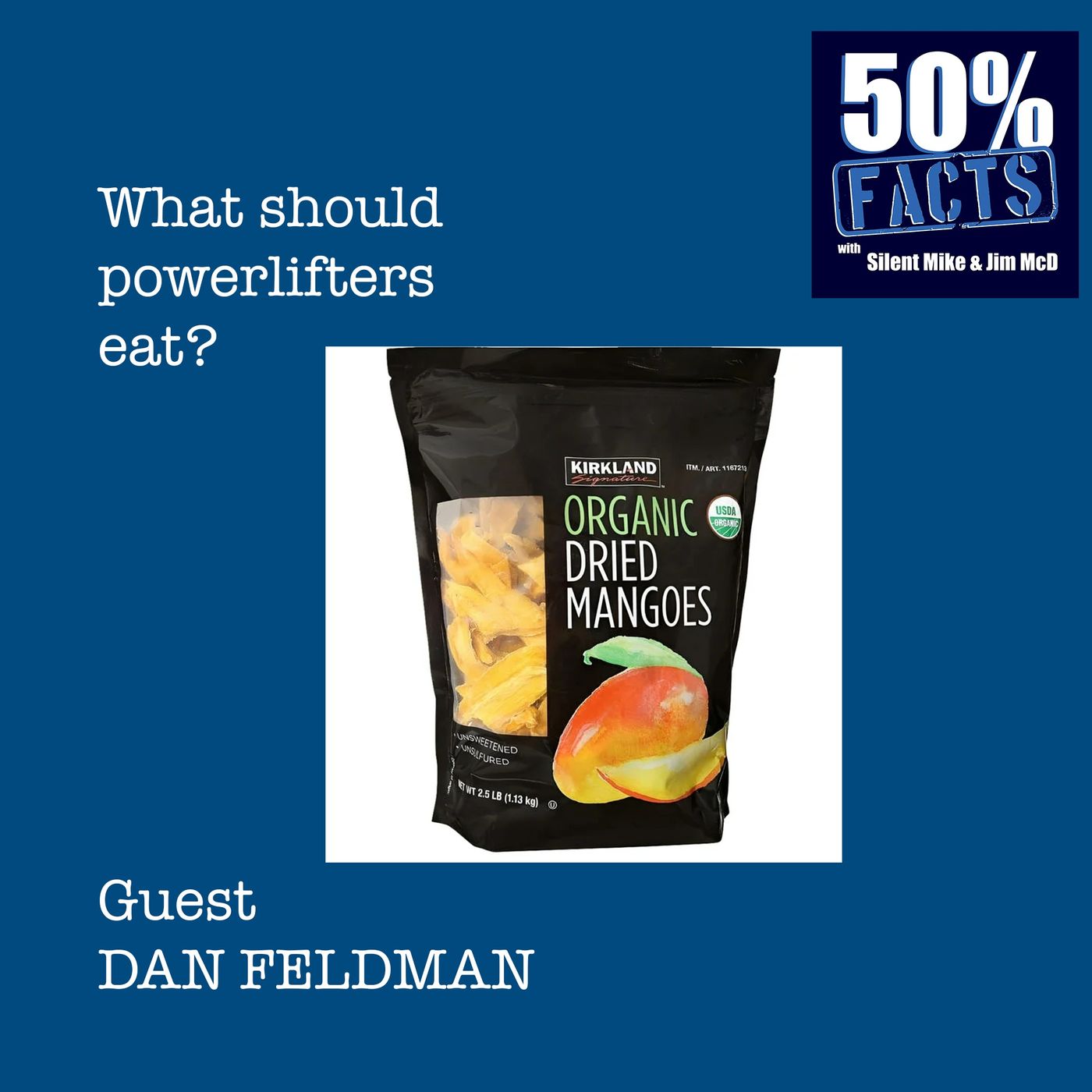
What should powerlifters eat to maximize performance? | Guest: Dan Feldman, RD

 Apple Podcasts

 Spotify

 Goodpods

 Audible

 iHeartRadio

 Podchaser

 RSS Feed

 Castro
Powerlifter and Registered Dietitian Dan Feldman guests this episode to break down some nutrition strategies for competitive powerlifters. Is a crazy amount of protein necessary? Are carbs around workouts good or bad?
You can find Dan on Instagram @powerlifterdietitian https://www.instagram.com/powerlifterdietitian/. Shoot him a follow.
Join our Discord for free at goodcompanydiscord.com!
Check out our gym (Third Street Barbell) at ThirdStreetBarbell.com https://www.thirdstreetbarbell.com/!
Check out our podcast website: 50percentfacts.com https://www.50percentfacts.com/
50% Facts is a Spreaker Prime podcast on OCN – the Obscure Celebrity Network.
Hosted by Mike Farr (@silentmikke) https://www.instagram.com/silentmikke/ and Jim McDonald (@thejimmcd). https://www.instagram.com/thejimmcd/ Produced by Jim McDonald Production assistance by Sam McDonald and Sebastian Brambila. Theme by Aaron Moore. Show art by Joseph Manzo (@jmanzo523)
Become a supporter of this podcast: https://www.spreaker.com/podcast/50-facts-with-silent-mike-jim-mcd--5538735/support.
0:10 Okay, today I've got Dan Feldman. You might know him on Instagram as the powerlifting dietitian Dan. Just tell the folks a little bit about you, a little bit about yourself. Yeah, thank you Jim for having me on. So. Yeah, like you said, obviously, my name is Dan Feldman. I am known on Instagram as powerlifter Dietitian. Very original, very original name. Obviously, I'm a I'm a decent powerlifter. You might put up some halfway decent numbers on a local on the local level, nothing anything too crazy. And also, obviously per my username, I'm also a registered dietitian here in the US based in the New York, New Jersey area.
0:51 Also my master's degree in human nutrition. You know, spend much of my time seeing patients, seeing clients one on one, usually you know, weight loss, muscle gain, that kind of thing, although occasionally I work with you know, general pop folks who maybe have like pre diabetes or high cholesterol or stuff like that. Yeah, so pretty much much of my life is focused around obviously dietetics, working with patients, and trying to be a halfway decent powerlifter. Yeah. Cool, what are some of your numbers? Just out of curiosity. Yeah, So.
1:33 In competition, my best squat is I'm just gonna do pounds and I'm not doing the kilo math right now for whatever the the kilo equivalent it's like four twenty seven ish pounds they're about, And I compete at the one to sixty five pound class, so relatively small guy. Bench Press and competition, my best bench was three nineteen and then in competition deadlift was five eighteen. I have done bench press three thirty in the gym, and these days I've been doing like squats like four to twenty five. The other day it did four to twenty six for a triple.
2:14 So decent. You know, I would take it in my side. Obviously not breaking any national or international records or anything like that, but I you know, like I said, I would consider myself a decent. Powerlifter. You're in it, You're you're committed to it, You're you're doing it. That's that's the important part, right Yeah. Yeah, And actually I noticed from your Instagram the day that you were also actually jacked, so that's always helpful. I I appreciate the compliment. I tried moderately. Moderately, you try moderately or you're moderately jacked. I am moderately jacked. Also, I'm five foot four, so whatever muscle I do have, there's just not that much surface area for it, so it to some extent there's a little bit of an illusion there's.
3:00 Sticks out, is what you're saying. Yeah, yeah, I will take the compliment. Though. We have a lifter here in the Jim RJ who is about that height. Maybe I think he might be a little bit shorter, but he is just crazy jacked. Like I was walking past him the other day. And was like, dude, your shoulders are so wide, particularly compared to your waist. It's like, good lord. Yeah, most of us will. Never ever hit that point in our lives. We will never will never be like that. It's it's great. Yeah, it's one of the benefits of being so short, is that, like I said, the muscle that I do have, it doesn't have that much area so so so it's helpful in that respect.
3:44 Yeah, for sure. How did you get interested in becoming a dietitian. Yeah, so I actually originally wanted to be a professional musician. I was related to playing guitar when I was younger, classically trained, and then you know, kind of started to lose some interest in it. I became so obsessed with it it became like work. So then freshman year at college, wasn't really sure what I wanted to do. Tappen to take a basic nutrition class, really enjoyed it. I also have my own history of disordered eating, which I can get into if you want, but there was and actually my senior year of high school, I started to get into lifting a little bit, like just basic tricep dips, pull ups, that kind of thing. Really like this nutrition stuff.
4:30 Spoke to my academic advisor. She said, you could do dietetics and become a dietitian. I didn't know what that meant, but it sounded very official, so I thought, sure, I'll do that. And then I just kind of kept doing the schooling and continue to be pretty interested in lifting and body compositions. So it kind of seemed like it made sense. Also, it's a lot easier to make a good living being a dietician being a healthcare practitioner than being a professional musician. You know, there's a lot of kind of luck that involves in being a professional musician. So yeah, that kind of brought me to wanting to really focus on nutrition, and that kind of you know, really started the ball rolling. I think what I've observed about professional musicians is that it is often easy for them to find a work.
5:14 It's hard to find money, right, right, It's hard to get paid enough to make it to make the juice worth the squeeze. Yeah. Yeah, that's from my understanding. And again, this was going back like thirteen years ago, and I was like obsessed with playing guitar, and yeah, at that point it just seemed like the smarter decision to at least just for me personally, to keep music is more. Like a hobby. Also, like I said, music, it became I was so obsessed with it, playing like six seven hours a day of a guitar at one point that it eventually just kind of felt like work. Yeah, yeah, yeah, I can totally understand that. Who in the in the in our fitness industry, who deals with diet do you find inspiring?
6:05 I mean a lot of folks these days. I really really like the folks at Monthly Applications and Strength Sports. So that's mass so Eric Treuxler, Eric Helms, Lauren colenso is simple and MI like zerdos And then as well as Greg Greg Knuckles over at Stronger by Science. He used to be at mass as well. Those folks have. Really been following for a long time since the Monthly Applications and Strength Sports Nutrition are nutrition and training researchers you came out back in twenty seventeen. You know, they always put out fantastic stuff, very much evidence based content and kind of reading their stuff really got me into like actually wanting to read nutrition studies and really trying to be relatively evidence based kind of that along with my master's broker, which really focused on nutrition research. So those folks in particular, you know, I really really found interesting, you know in my early days of of of just watching like YouTube fitness, like back in my early days, like my freshman sophomore year of college, when I was first really getting too nutrition and lifting. I mean you had og Elliott Hols, you know back in the day who and then obviously right right right h. I don't follow them these days, but back in the two thousand and seven, two thousand and eight as well as o Mari stuff you know back in the day is also one of the original YouTubers, and I mean for the
7:36 last decade Jef Knip British journal have been putting out really good content. So those folks and like I said, the folks at mass a monthly application Strength Sports Stronger by Science three D m J. You know, the the Nutrition and Muscle Pyramid books by Eric Helms and and Andrea Veldez and you know that, uh, you know and A. D. Morgan, that group of folks. So really I've kind of drawn inspiration from various people in the fitness industry who I've kind of growned the trust, you know, over time, and I can help shake my thinking around, like interpreting science, you know, and interpreted Actrician to be science, that kind of thing.
8:19 Yeah, some of those folks are definitely friends of ours here, Eric Eric Helms Omar three D m J folks definitely dealt with them for you, off and on for years. Eric Helms is one of the nicest people on earth. He's like, he's like so nice that you're you're almost uncomfortable because you don't because you feel like you don't don't measure up to how nice he is. Yeah, yeah, yeah, every I mean I haven't had that many interactions with him, but I've never heard anyone say anything negative about him. The only people I've heard say negative things about him not going to need names or like people in the fitness industry who are like universally like not well liked.
8:59 Yeah, yeah, And you know, you're you're talking about a real like one side of a dichotomy. It's like very science based people, very very contemplative in there in their recommendations. They don't follow they don't follow trends. They they don't follow hype. They're you know, very grounded versus like so much of the rest of fitness is just it's hype. It's made up stuff. It's fear appeals, things to to to appeal to your insecurity or hacks, which is one of my least favorite words in the whole world.
9:40 Now. And uh, and you know you're you're obviously you're falling on the on the side that we are more comfortable with, for sure. I don't know the last time I actually had an interaction with one of the folks on the other side, but it is, you know, it's it's all kind of calculated to sell something, either sell a person or sell. A product or some group of products or whatever. And the product stuff if they don't own it themselves. The you know, their loyalties and allegiances change with whoever's. Paying them, and it's that part of the industry I just find really depressing, honestly, agreed. Agreed.
10:20 I mean, it's you know, a lot of the basics around nutrition in training, and you know, ninety percent of what gets you your results is the boring, not so sexy stuff that we all kind of already know. Basic training principles, basic nutrition principles, and that other like little bit of optimization is what a lot of folks in the fitness industry really try to whether it be fear mongering that this food is terrible for you, or you have to eat this food, or you have to do this kind of fasting. There's certain supplements you know, or products or what have you that sound really cutting edge and groundbreaking but really. Don't do much. That's that's really where the profit is, right, So that's you know a lot of where that comes from. It, you know it, I don't think it's really going anywhere.
11:03 I think it's just the nature of you know the fact that people generally aren't going to buy products based on kind of like the basic stuff that we all already know they want to hear something cutting edge and new and novel and hacky and what have you. Right, for sure, obviously you're you're a powerlifter. You you work with powerlifters as well. Yeah, to some extent, I've got, you know, a handful of powerlifters who work with me, just you know, as someone who is not only a dietitian but also power lifts. A lot of people find like they want to see a dietitian who has some experience with that, you know, because for dietitians who might not be so much intol like the powerlifting scene or whatnot, they might just not have that same hands on experience.
11:48 So, yeah, I work with a handful of powerlifters. What do you find is different about them? Is it is there a personality thing or is it the demands that they put on their body from you know, lifting heavier weights than most folks. Or Yeah, I mean, I think there's obviously going to be a larger emphasis on recovery, but also just the goals are different, you know what I mean, for general, for general population folks. And also keep in mind, I'm seeing pretty much exclusively people in the United States, and mostly people who are you seeing me through their health insurance actually bill, you know, patient's health insurance. So a lot of general population.
12:28 Folks are you know, folks who are just. Your typical American who maybe have twenty thirty forty sometimes one hundred, two hundred pounds to lose and have high cholesterol, high blood pressure, you know, or things like that, where the goal is more so long term weight loss in health, whereas for powerlifters, obviously, competitive powerlifters may not be as focused on their health per se for better or for worse, and the goals might be more so specifically for performance or for you know, for for competition, wanting to have a high high or dot score, wanting to. You know, perform well in. National or international level competition. So just the end goal oftentimes is much different, you know they are, so obviously it might just be a different set of priorities to some extent compared to someone who's just like a general population person who just wants to be overall healthier.
13:26 Right in terms of your recommendations for them, what is like a performance nutrition uh set of recommendations versus versus weight loss versus and for some people weight gain, Like what are the what are the differences across that spectrum. Right, So for someone who is is powerlifter and is strictly focused on powerlifting performance, you know best dot score, wanting to compete at a high level, and they don't actually care that much about health per se. And this isn't to say that health doesn't matter, because you know, obviously you can't be a good powerlifter if you're dead from heart disease. But just in a vacuum, if you're just focused on powerlifting as the main outcome, generally speaking, the main kind of thing to prioritize, and again obviously in reality something you have to have some focus on health just so you you know, so you can like live a long time. But apart from that, in no particular order really for things, one fueling session so you perform your best at each session. I know that sounds kind of obvious, but you know, just overall, you know enough calories and protein and carbohydrates. You know, there may be some potential fueling considerations around training sessions. Basically to make sure that in training sessions you are energized and ready to go and train effectively while not feeling super bloated in your training session due to eating you know, something high fat or fiber right before having to use
14:58 the bathroom excessively. You're just being really tired, so fueling sessions to perform your best and again no particular order recovery after and between sessions. So again that's really having enough calories and enough protein as well as enough carbohydrate to avoid you know, muscle glycogen depletion during sessions, of recovery between sessions, gaining or maintaining muscle mass since as I'm sure most people listening to this, no being strung ultimately comes down to generally speaking, your proficiency with each lift, you know, having the kind of coordination and efficiency to use your muscles as efficiently as possible, but also just having as much muscle as possible, since more muscle generally can can can push more weight. So gaining muscle, you know, you just obviously plays a big role in that we're maintaining if you're in a deficit, So that's three, then four, maintaining a body fat personage so that a lifter can be in a relatively competitive weight class. So if you obviously have like an extra hundred pounds of fat, that might be disadvantageous in terms of what weight class you're in, but also not a body fat percentage. It's so low that it negatively affects performance, such as by messing with your leverages or like tanking your testosterone or your energy levels, you can't perform well.
16:24 So again, obviously. Health matters, but if you were just focused on powerlifting, it would be again performing your best in the gym, recovery between sessions, gaining or maintaining muscle mass, and maintaining an appropriate body fat level for your weight class. Those would generally be the four things strictly in terms of powerlifting you'd want to focus on. Obviously, if we wanted to kind of talk about more broadly general health, there's a lot that goes into that, but those would be the main thing strictly for powerlifters. Well, what do you think like a good body fat range would be for a competitive power. Yeah, that's a good question. I need to have a definitive answer. But just like what your opinion might be.
17:09 I would say it's and this is really just this is really kind of ballpark, may or may not be, you know, totally accurate. I think it depends maybe ten to fifteen percon there may be ten to twenty percent for men, whereas. Although actually for. Men that are more heavier and like higher weight classes, higher body fats might be a little bit kind of a little bit better, you know, just from the little amount of research that I could find, which was very little. Yeah, ten to fifteen percent for lower weight classes, and then for mail lifters like above two hundred and forty pounds. Again, this is just men. I'm talking about body fat percentages in like the twenty four to twenty seven percent range for men who are particularly hot, like who have a higher way more as for women, I was able to find almost no real research. I think I found one study that was I want to say, like thirty percent ballpark, but that was based on like one study that I was able to find. So basically, I don't think there's really enough data to just kind of say firmly for sure, but I would say more so on an individual level.
18:41 You know, you'll know if you're too lan if again it starts to really negatively affect your leverages, you know, or if you're just super tired in the gym. So, like I said, maybe ten to twenty percent for men, for women, it's going to be higher, but there's just not that much literature on that that I could find. And the other piece of this is that actually measuring body fat accurately is very, very difficult unless you have access to like a dexa like the home scales that you know. People might have commercial scales that can supposedly measure body fat. Those use bioelectrical impedance BIA, which basically sends a electrical current through your body, with the assumption that the electrical current will go faster through tissues that have more water, such as muscle, and slower in tissues that have less water such as body fat, but hydration can dramatically affect that. Also, if you're using most at home scales, you just step on it, so it's really kind of more assessing the lower body. In a laboratory setting and a research setting, they'd have electrodes on your hands and feet. So basically very difficult to assess body fat accurately. Some of the at home scales can do a decent job of assessing changes over time, but in terms of just kind of figuring out exactly where your body fat percentage is, I don't think it's particularly effective
20:13 to say, hey, you know, because Dan filled in on this one podcast said maybe men ten to twenty percent, my at home scales is twenty one percent, then I should lose fat, you know what I mean. It's we just don't have great ways of measuring it. And the threshold at which you're getting kind of too lean whereas you know you're getting leaner than your body really wants to be, and then you'll see performance decraments. That also just anecdotally varies some person in person. You know, I know some lifters who are my height who maybe they compete in like the eighty fours, and they maybe they have like twenty two percent body fat, but they're competing at nationals, you know what I mean. So there's a lot that really goes into that.
20:54 So kind of from a practical perspective, if you're a lifter, you know, and you know you're caring some extra body fat, and most people they know if they are, you kind of just have to see how lean you can get while still maintaining your seam level of performance and having decent energy levels and not being super hungry. So that's really kind of the best I can provide there. I think that the higher body fats the question is like mobility, Like can you can you squat comfortably? Can you get down to the bar to deadlift comfortably? That's like you especially for guys, or you had kind of a gut in the way, it's it is difficult to get down there and get set up.
21:42 Well. I you know, I came into power lifting during the geared era, and like, not everyone was fat, but pretty much everyone was fat because because you sort of needed that extra body weight, and it was easier and faster to put on fat than a ton of muscle. I mean that that definitely takes more time and the gear just fit better if you were fatter, just it just did mean it was it was more supportive and and and all. So that's you know, that's like I had never weighed over two hundred pounds before I started powerlifting, and it was like kind of imperative for me to get to get there for for the gear to work.
22:25 Not that I was like terribly competitive, but you know, you try to do the best you can regardless of. What your your limitations are. I guess, yeah, yeah exactly. And I mean definitely for squat and bench, having some some some body fat beyond being like super lean will likely be beneficial. It'll give you a little bit more balance out of. The hole, you know, for for squats, to have a little bit of extra body fat, you know, kind of the stomach area. I know, when I've gotten very lean, it's like the hole is not a fun place to you know, where you just get like no bounce and it's And then with bench having a little bit of fat on your your glutes or your chest can help can reduce the range of motion, whereas obviously if your stomach is too big with dead lits like you said, that could provide it, that could can make the lift more difficult. So it's also going to vary depending on the individual and bodycat distribution, which you can't really control.
23:23 Yeah, for sure. Do you think that there's a another type of athlete that's comparable to the to the requirements of a powerlifter in terms of diet nutrition? Not not necessarily, I mean I think in kind of like a broad sense, just in terms of the requirements in terms of having like as much muscle as possible. Obviously you have bodybuilding, so there's going to be some overlap there, but obviously there's with bodybuilding ultimately, if you're gonna be on stage, you have to be pretty much as lean as humanly possible, which is not the case for powerlifting, and you don't have to worry about performance.
24:07 You know, you can feel like absolute garbage. As long as you can pose for like two or three minutes, you're good. So, I mean, I'm sure I don't really work with Olympic lefters, but if I did, I'm sure there would be some overlap there to some extent, but I can't really say for sure. But other than that, not really that I can think of. I think it's pretty unique in terms of you know, ultimately you really just need to be able to do nine singles in a day, right, So there's definitely gonna be a lot of individual variation. There a question that I that I sort of posed to you offline before we started this actually when we're talking about getting together.
24:58 Was. What powerlifters should or could eat around around workouts. And I will say this as from the perspective of a gym owner who has a vending machine. The demand is for things like mango like sweet and sour candies, whichever whichever one nit you're you're you're vibing with pop tarts. Uh, you know, we have low fat chips, we have, you know, all of that kind of thing, and and there is a really a lot of demand for just like carbie stuff during workouts. What's what's your feeling about that?
25:49 Yeah, No, I think, I mean it's very reasonable in general for fuel right before or during workouts, it's going. To be mostly carbohydrate. Focused, kind of taking a big step back in terms of just overall before pre and enduring workout nutrition. The farther back, like hours before workout, the more likely you're going to be including things other than just carbohydrates. So, for example, going three to four hours pre workout, that's gonna be a little bit more of like your balanced meals, a combination of carbs, protein, as well as some fat and fiber, because you're gonna have a lot of that time to digest the food. Kind of one to two hours before, it's mostly gonna be carbs and more so you're kind of fast digesting carbs that are relatively low in fiber, you know, so that could be your your gummy candies, your sweet candies, your your lower fiber ruit like mango or banana, and maybe some protein as well.
26:55 One to two hours before, just to help with satiation, and then it's really you know, within an hour of your workout, if you're eating something, it's gonna be those fast digesting carbs with really pretty much no fiber in them. So it could be dried fruit that could be like your sweet or sour candies that are nation that are naturally fat free, like your Twizzlers, your gummy bears, your sour Patch kids, stuff like that, or you know, if you wanted to do you know, potentially like rice cakes or like like I said earlier, like a banana or like white bread, you could do that as well. And then during your workouts, if you are going to have intra workout fuel, it would be pretty much just carbohydrates and very much carbohydrates that are pretty low volume fruit snacks or like I said, some of those gummy candies, or potentially like maybe more so before like pretzels. Now, that doesn't mean that it's necessary to have intra workout or carbs during your workout or right before. It would depend on depending on various contexts in terms of like what you wait in the hours before your workout. You know, if you're going in fasted then having some intro workout or or having some carbs right before you train might be beneficial as well as if you are training with higher volumes, so sets with more reps. You know, if
28:26 you're doing like sets of fifteen, then you might want to more so have those intro workout carbohydrates rather than if you're doing like singles or doubles and longer workouts in general, will will You'll tend to find that the intro workout carbohydrates will be more likely to be beneficial, but in no way are they necessary. And again, if you're going to be doing like a workout for lank an hour, maybe you've got a couple of compound movements in there, but then a lot of isolation work you may not need, you know, intra workout carbohydrates at all. It really depends on, like I said, the individual a lot of individual factors, which I mean I can get into a little bit further. I mean, in general, it sounds like the stuff that you have stocked in the you know, vending machine makes sense, mostly carbohydrate based stuff pretty much.
29:18 Yeah, how do you feel about sports drinks like Gatorade or. Yeah? I think yeah, so if we're talking about sports drinks, that are you know, pretty much carbohydrate based and have some electrolytes. Certainly, if you're sweating during a workout, I think an electrolyte based carbohydrate sports drink I think is a really good idea is to replace those electrolytes while you're working out. And you know, again, if you have a. Pretty long workedout, higher volumes than some of those carbohydrates you know in quick forms, so just a liquid carbohydrate can be beneficial, you know, if you are. If you, on the other hand, have a little bit of a shorter workout and maybe you're doing more singles and doubles and you're not really breaking sweat, then I think.
30:01 The electrolyte portion is largely. Unnecessary, and you know, the carbohydrate portion might be unnecessary as well. You know, so again. Generally speaking, as far as electrolytes go, if you're sweating, probably a good idea to have electrolytes. If you're not sweating at all, not really necessary. And like I said, as for the carbohydrates, you know, if you aren't doing super high volume work or the workout isn't super long, it's largely unnecessary. Whereas if you are doing higher, higher reps, more volume, longer workout, you know, especially if maybe you didn't have a lot of carbohydrates beforehand, or if you're in a calorie deficit where you might be more likely to be partially glycogen depleted than having those carbohydrates right before or during your workout to maintain stable blood sugar levels so that you don't have to rely much on muscle blae pagin, you know, it would be somewhat beneficial. So I know it's kind of seems like a lot there's a lot of context there, you know.
31:08 I think if if you want to be if you're a lifter and you. Kind of want to just be prepared, I personally always have like several packs of fruit snacks, just welsish fruit snacks. In my bag at all times. So if I just kind of feel like I'm dragging a little bit or feeling a little bit light headed, or I just am feeling like slightly hungry, I can pop a couple of those takes up like no room in my stomach, you know. So so I think that's a better safe than than sorry approach. So, Okay, just depends on how long the workout is in the volume. I think if like, if you're honest with yourself about how you're feeling going into a workout. You you often like, know you need to put you might need to put something on your stomach just because you don't feel just don't feel great going into it, and you want to you want to feel like you can perform your best, because I mean, that's the that's the point of training is to do your best and to to prepare yourself for for competition. For most people. Yeah, so yeah, I know I've been lately losing weight, and before I before I lift, I do sort of check in with myself.
32:19 It's like, do I feel like I need something before I go out there because it's been X number of hours I've only I know, I've only had this many calories today And am I just going to feel like crap. In the middle of this? Or am I going to be are going to be okay? Yeah? Yeah, And you know, especially if you're in a calorie deficit and you are losing weight, you're not going to have as much carbohydrate availability just because you're not eating as much, you know, and you're, like I said, your glycogen levels distored carbohydrate and your muscles maybe partially depleted. So that's when that preer inchro workout carbohydrate may be extra beneficial. And again, I think with a lot of this, as a lifter, you kind of have to know yourself, you know, And because I can kind of give these recommendations based on studies or just based on kind of overall and like the same thing goes with what weight class or what body fat.
33:12 Percentage is best. Again, you kind of have to feel for yourself. There are some people. There might be some guys where like if they go below like twenty two percent body fat, they just don't feel as good. You know. So it's really about knowing yourself and really paying attention to your own body. You know that that's really important. What are your just overall feeling about food quality? We're just basically we're just talking about like you know, vending machine snack kind of stuff, but like in general, like over what people call overprocessed foods or like highly palatable stuff versus you know, you know, very basic meat, potatoes, fruit, salad kind of kind of situation.
34:00 Yeah, So, and this would kind of go more to just like overall health rather than like strictly power lifting. I mean, obviously it makes sense to have the majority of foods you consume generally, not the ultra processed foods, just because the ultra processed foods oftentimes tend to be hyper palatable, so they tend to make it the highperpalable foods means it's harder to stop eating them. You know, they're very sweet and very calorically dense, and then that can lead to overconsumption. And oftentimes ultra processed foods are also lower in nutrient density, whereas having a lot of your nutrition consist of food that are less processed and more nutrient danse, So your fruits and your vegetables, you know, proteins, especially leaner proteins, so like your chicken and turkey that's not breaded or fry, taking some of the skin off bee for pork, where it's it's like a lower fat version, low fat dairy eggs and egg whites, you know, as well as getting a good amount of grains, so you have a sufficient amount of carbs, especially whole grains. You know, all of this basic stuff. Having fats that are more more social implants just from a general health perspective is good.
35:26 Now. I don't think. It's necessarily the processing because a lot of people just think oh, food is processed. That means it's bad, you know, which is not necessarily the case. Nor is it necessarily the case that if a food has a lot of ingredients that it's necessarily bad for you. It's just that the. Foods that oftentimes are less processed are oftentimes the foods that are also less calorie dense, you know, so fewer calories program, which majority of Americans who you know, probably could lose weight and improve their health, you know, it's it's beneficial for you know, for that reason, foods that are a little bit lower, less process tend to be a little bit better. But again, it really comes down to you ensuring that your diet ensures that you consume an appropriate amount of calories for your goals. So if you are trying to lose weight, then that would be lower calories. Or if you're someone who's trying to maintain a relative state of leanness and you tend to struggle with your weight, then you know, paying attention to the calorie density of your foods. So foods that have fewer calories program and that's going to generally be foods that tend to be lower processed, like your fruits and your vegetables, you know, especially as well as you know, having a diet that allows for an appropriate amount approaching carbons in fats and is just relatively dense and vitamins and minerals.
36:54 So again it's not that the ultra processing is the cause of why diet might be lower quality, but it's just the ultra processed foods tend to be lower in vitamins and minerals and tend to be a lot easier to overeat. And again that's relevant to powerlifters in terms of like wanting to be relatively healthy, so you're around for a long time, so you can you know, lift for many years and be disease free for many years. So that's kind of what I would say. And you know, something I've said many times is that you know, boring nutritional advice is usually correct nutritional advice. So much of your diet, you know, consists of like I said, low fat proteins, like I mentioned, relatively low for saturated fat, getting more of your fats from plant based foods.
37:43 You know, having a d cinemata. You start to be whole grain, tons of fruits and vegetables, limiting fried foods, limiting sweets, basic stuff, you know, that's really kind of what's most important in terms of general health. So I don't know if that answered your question or not. I know it does, it does exactly do you use I'm asking everyone this question. Do you use tracking apps with your clients? I do? I do? I mean I I would say about half my clients track their track their calories and macronutrients. I don't force my clients to track per se because I also, like I said, I do work with a general population. And while to be honest, in a perfect world, if I could just if everyone were if everyone I saw was like a robot and they could just follow all directions, I would probably tell everyone.
38:34 To track their nutrition. However, not everyone is able or willing to do that. You know, not everyone is technology technologically savvy. Not everyone had the mental capacity to do that. So I also kind of have to work within the realm, within the bounds of people's sustained what people can can can realistically do you know? But I do for my clients who are willing to do it, I do encourage it. Especially you know the app that I use, it's macro Factor. I'm sure you're familiar with. It actually makes it very pretty easy to track. They have like a picture function now where you can actually take a picture, give a description. Literally used it last night.
39:19 I went out pretty late. I had a burger and fries and some Voka diet cokes, you know, not to help theest thing in the world, but I was able to take a picture or describe it and I got it tracked. So I do generally encourage tracking, but it's not right for everyone. Yeah, I understand. And really the the the sort of two things in my mind about tracking apps. One of them is easy of use, and the other one is the accuracy of their database. Yeah, yeah, you know, and and I bitch about this all the time, but so much of what's in their database is prepackaged stuff that already has all the nutrients you know, and macros and everything listed there. And they're just someone just them all in and or you know, shot them with the camera or whatever, and it is isn't necessarily accurate to.
40:11 Like home prepared foods. And with home prepared foods either, like sometimes you can take you can you can take the picture and let the the AI try to figure out what's there, and sometimes it's accurate. And then sometimes it's it's inaccurate, and you have to like try to break down each component of it, and and that can be frustrating. This is a personal frustration of mine. I've kind of I'm kind of like during a tour of the apps. I use a macro factor for for quite a while in the past, and I'm sort of doing a tour of other apps right now, and and none of them really makes me happy. Yeah, it's been a couple of years as I use macro Factor and go back and try it again.
40:54 Yeah. Yeah. The and the actually, the the for macro Factor, particularly the AI is it's very recently, like it's it's pretty new in terms of what it has now. So if you haven't used in a couple of years, I would I would consider going back to it. Obviously, taking a picture of a food is not going to be as accurate as actually weighing each ingreinent. That's just kind of the way it is, you know what I mean. So I do generally find it helpful just because even if it's not going to be perfect, at least it's tracking something. Because with a lot of. People, what happens is they you know, maybe the track for a few days and then they have like a meal like I had. Like I said, I went out last night at like eleven pm. You know, I'm not going to bring my food scale with me to eat a burger and crawludd and ketchup and all of this. But I was able to put something in, you know, and just keep that habit, you know.
41:46 And I mean, what I would say to a lot of people is by initially, when you're at least at home, by going through the trouble of actually weighing things like if you're going to make a dish, like weighing out the raw meat and weighing at each component of it and going through that process. It's annoying, yes, but after a. While, it also teaches you to. Kind of how to be able to eyeball something and get a ballpark estimate of how many calories are in it. So that way, then if I do use the AI may or may not be accurate, so then I conjust it accordingly based on just kind of what I know from having tracked accurately. So it takes work, you know what I mean. So it's definitely not always the easiest thing in the world to do, you know.
42:29 At the same time, making. You know, losing weight in. General is not the easiest thing in the world to do, and it's always yeah, and there's always some degree of discomfort whenever we're trying to make a positive change. You know, same thing goes with lifting. You know, if you want to be a really really really good power left there, there's going to be some degree of discomfort. You know, you won't feel like going to the gym, but you go anyway, you know what I mean, Or you feel like kind of quitting mid session and you keep going. You know, that's just kind of that's just kind of how it is. You know, with any. Sort of arduous goal, there's going to be some level of discomfort. And for some people it might be that the tracking, at least initially is annoying and tedious. Sometimes we have to just do annoying and tedious things, you know.
43:17 Yeah, true enough, Yeah, true enough. Yeah, Just speaking of of of macros, I think that unless somebody is and no one should ever be a carnivore, right, getting enough protein is sort. Of a universal problem, right, it seems to me. Do you have any tips tricks that would help people do that? I? Right, so, well, first I would be curious as to what people think is enough protein obviously a real question. Yeah, And obviously protein is going to be pretty important in terms of recovering in terms of gaining muscle. However, I do think the importance of like getting exactly one gram propound or whatever is a little bit overstated in that for building and maintaining muscle, Like you don't want to eat low protein, but I would say that resistance training and actually having a sufficient stimulus to either grow or maintain muscle, and then two eating enough calories so that I mean you can be in a calorie deficit but not too large of a calorie deficit. Those two things are actually more important than the higher protein. The higher protein kind of facilitates those processes. So you know a lot of people that are using app be a macrofactor.
44:40 Be at my fitness ball on it says they need this high amount of protein. Maybe it says they need two hundred grams and they get like one hundred and fifty and they think, all crap, I didn't hit my goal, Whereas the actual difference might be not huge. So I think, first off, it's just understanding the relative importance of protein, and it's getting exactly, you know, like the perfect amount, And it also depends on your level of competitiveness. Like if you're a world class powerlifter, yeah, maybe really emphasizing getting a little bit more protein, uh, it would be important. Whereas if you're just a recreational gym goer or just kind of like a powerlifter trying to make some gradual progress, a difference between like one hundred and fifteen two hundred might be minute squil So that's the first thing, you know, in terms of how much, I mean, there's a lot of different recommendations out there. I think zero point seven grams to one gram per pound generally speaking, would be kind of like the optimal amount unless someone significantly overweight, then it's going to overestimate your protein targets. So you know, I would say zero point seven to one gram per centimeters in height. You know, it would be better if you've got a significant amount of body fat.
45:51 That's just ballpark, you know. So and I think for a lot of people, for a lot of people, actually that point seven it's just fine. So you know, point seven grand per pound if you're relative lean lean or put seven grand percentimeter in height. You know, I think you're not gonna get that much more benefit than that amount, unless I mean, if you're if you're a bodybuilder and you're like nine percent body fat, you know, I would try going a bit higher. So that all of that is to say, like, I don't think people need to stress about every single gram approtein, you know, and even the recommendations I just provided, or a little bit off the cuff. There's also just one last thing I'll sometimes use, and this is also for folks who are not who who have extra body fat.
46:43 I'll use something called the ham We equation, so one hundred. It's it's used in the clinical setting for ideal body weight. I don't recommend using it for ideal body weight for powerlifters because it'll it'll tell all powerlifters they need to lose weight. But for women one hundred pounds for the first five feet in height, and then five pounds for each additional foot for each additional inchin height, and then for men one hundred and six pounds, one hundred and six pounds for the first five feet in height, and then six more pounds for each additional you know, inchin height. I don't recommend actually using for ideal body weight, it would tell me I'd have to lose like forty pounds. But I would say you could also use that as a number of grams of protein, so.
47:31 As I would say, use that as kind of like a lower estimate. So if you have a woman who is five foot six, so one hundred for the first five feet in height, and then five for each additional inch, so that would be one hundred thirty grams of protein. Right, that math makes sense. Or for me, I'm five foot four, so that would be one hundred and six, and then six for each additional inchine height, that would be one hundred and thirty. I think I did that math right, right. So those are a. Couple off the cuff ways that you could kind of see or sometimes I'll use that equation into the lower boundary and then centimeters in height as the upper boundary. So those are just again just kind of the general idea is that you don't have to obsess as much over protein as you think you do. But to get back to your original question as to how to kind of make sure getting in the protein, this is one of the few instances where supplements are actually extremely beneficial, specifically protein supplements. I mean quite frankly, if you don't have some kind of dairy or way intolerance, I would just say get a big for it to be as cost effective as possible. Eat as long as you can eat dairy. Get a big five pound thing of weigh seventy bucks on Amazon, have two scoops a day with low fat milk or skim milk, which is going to be pretty cheap.
48:51 That's going to get you like seventy grams right there. And then if you just eat food that's like relatively dense in protein, you know, your chicken, your turkey preferably without the skin, lean low fat cuts of beef and pork, fish that's not bread at or fried eggs, especially egg whites, low fat dairy, you're gonna do just fine. And then obviously, you know, if someone who's vegan, they can do like a vegan protein powder as well, you know, or if someone doesn't eat dairy, they could do like I said, peat and rice based protein, or they there's a lot of different fruits and powders out there, depending on taste. You know. Some people are pickier, like.
49:31 I can just down you know, like like a protein shake without even thinking about it. Some people if they're even. More sent more delicate palets they might want to do, like pre made protein shakes like fair Life, you know, or potentially protein bars you know, you know, or again, if all else sails, just try and get a lot of protein from your diet, egg whites, you know, low fat fat, very dairy stuff like that. But I, like I said, I think it's where this is where the supplements one of the only areas where supplementation is actually very very helpful just from a practigality standpoint and a cost standpoint.
50:12 Yeah, I think that it's almost impossible to get to the you know, even sort of the minimum recommendations without extra. If you're if you're really really paying attention to it. Yeah, And a couple of other like possible calculations I've heard as one of them in particular is just is making the the doing the calculation at point seven or point eight or whatever on your. Target body weight as opposed to current body weight. You could do that. You could do that too. My guess is that if you were to actually do all these different equations out, it would probably be pre pretty similar. So like, regardless of the one you use, Like, I don't think it's going to make that huge of a difference, you can, yeah, you know, and and again because protein, like I said, it's important, but I do think it's a little bit overstated in terms of like how important it is to get like the optimal amount of protein versus like if you just make sure you're training hard and training for progressive overload and eating enough in the grand scheme of things, is it really going to make that much of a difference.
51:24 I don't think so. Yeah, I think that's that's common sense advice. I think that a lot of people get it just overhyped. On on you know, you need two undergrams of protein today or whatever, and it's like it's hard to do that. It's like hard to it's hard to get the right mix of macros in normal food even to get there. Kind of a final question that I've also been asking everyone about, and that is GLP one agonists. I'm sure feeling about them? What and and then if you're working with anyone who is on one, like what approaches have you taken with them? Because I think that what I see is that there are you know, like some.
52:08 Medical based. Systems where people are handheld through the nutrition part of it, and they learn healthy habits or whatever. And then there are other. Situations where people are just handed at the prescription and it's like go and you know, just you're not going to feel like eating as much as you're going to lose weight and it doesn't matter what you eat. Yeah, So I mean this is obviously a very like, very like I could talk for. An hour about this, I'm sure. Yeah, So a. Couple things, and I'm just going to talk about the United States in particular. These medications are strictly, at least as far as I know, approved for management of type two diabetes and obesity. Those are the two, and they are drugs. They're medical drugs, so people should really own only be using them if they have one of those those two medical conditions. Obesity is a medical condition with a diagnosis and with the prescription from a reputable healthcare provider to treat one of those two conditions.
53:15 A lot of people. It's not currently approved to be used for aesthetics, like if someone just wants to get a six pack, or a woman just wants to be able to fit in in like a bikini or whatever, Like, it's not that's not what they were studied for. Okay, so that's really the big thing. Number two is I do think that it's very important for whoever's prescribing. The medication to. Really give a lot of context in terms of, you know, how it should be used. There should be a lot of nutrition education as well as guidance on physical activity provided alongside these prescriptions. I don't think it should just be here's your prescription and go away. I think that be very unfortunate if that's kind of what happens. I see a lot of clients with with these medications. So, you know, generally speaking, really the big things are I mean, one of the big things is to when you're on a gl P one medication or one of them, to your zipotide is actually it acts on g LP one and g i p which is another you know hormone that can kind of assist in reducing hunger. Is making sure that clients that patients on these are doing some form of resistance training to prevent losses and muscle mass.
54:37 Now importantly, with the these medications. G LP one medications do not cause you to lose muscle per se it, but it causes you to eat less and then you lose weight. And with any form of caloric restriction or weight loss. If you don't do any resistance training whatsoe ever, some portion of that weight that is lost will be muscle. It's not the GLP one medications in and of themselves. It's just whenever. And it's the same as if someone is losing weight from bariatric surgery. It's the same someone's losing weight just from diet and exercise. If you're losing weight, if you're in a Caldari deficit, if you're not doing any resistant training, you will lose some muscle and it could also be potentially detrimental to bone. So doing weight bearing exercise, which most of your listeners are probably doing already, but a lot of general pop folks that get these medications aren't. So that's really one of the big things.
55:34 And then along with that, I know, I just spent however much time kind of staying how like protein, It's like not the most important thing in the world, but having a reasonably high protein diet just to further assist and the maintenance of muscle mass. Still, resistance training is the really big part. And I think this is more and so for folks who aren't in the fitness space, and who are getting these medications, you know, but who don't have that fitness background. I mean, those are really the two main things, you know. Otherwise, I think really the other really big piece is that you kind of have to stay on these medications forever. That's kind of how they were made. And I think a lot of people don't understand that, you know, and that's you know, a lot of people aren't comfortable with the idea of staying on a medication forever.
56:20 And then when people get off these medications unless they've they're really really paying close attention to their nutritional habits and have made permanent changes in terms of how they eat, in terms of their relationship with food, you know, so not necessarily using food as like a coping mechanism for you know, uh, dealing with different emotions, you know, and really eating a diet that's not so high and in calorie dense, high palatable foods. Unless you do really, really, really. Good job with maintaining those habits changes, oftentimes the weight will just come right back. And that's not a knock on these medications. Just speaking to the weight management part, Obesity is a chronic it's a disease and it's a chronic condition. So these drugs are really made to stay on them forever.
57:11 That's just how they are. And that's why again the idea of kind of people using them. For esthetic purposes, they're, like I said, they're just not really made for that, you know. So, so I'm not anti GLP one in any way whatsoever. I think these medications are actually for people who, whether it be for genetic reasons jar otherwise, who struggle with their weight literally their entire lives, and are naturally like tend to be food, tend to just always be thinking about food. These medications can be literally life life saving and life changing, but you need that context, and I think working with a provider who can prescribe it and who can really give the this detailed the ongoing kind of education and accountability as well as working with a Regigan dietician who can also provide that ongoing accountability hugely important.
58:04 Yeah. I think that for some people it's either you're going to go on insulin for for the rest of your life, or you're going to take a GLP one yeahs the rest. Of your life. That's kind of like and and I don't know why one of those sounds worse than the other, right, I mean the the people are generally going to be healthier if they're if they've lost weight and they can maintain weight loss on a GLP one agonist than trying to to chase a normal blood sugar level on insulin. Right, And I mean the insult taking insulin that would be more so strictly for people at diabetes, you know, whereas the g LP one medications you know, can be very beneficial for people with diabetes, you know, but also they have that weight loss component, and I mean the g lp one you know. Rather than just giving someone insulin exogenously that will kind of transiently reduce their blood sugar, the g l P one actually improves insulin sensitivity so that the insulin that you have or in your body currently works better, which is really really important. It enhances the ability of your body to respond to insulin appropriately because insulin, as most of your your audience may know, insulin's main job is to lower blood sugar. It does
59:35 that by enabling your cells, particularly like your musculine fat cells, to essentially suck up blood sugar from the bloodstream. And when you have insulin. Resistance, your body cells don't do as good of a job as that, so you can't absorb that blood sugar as well, so insulin you have to pump out more insulin to get your body to respond appropriately to insulin, and then eventually you can your your pancreask can have trouble producing more insulin, and it's kind of this whole cascade effect. Whereas the GLP one, especially the tear zepititide, which is also known as manjar or zet bound, it actually works on two different hormones, Like I said, g LP one and gip those both work together to really enhance your pancreas's ability to secrete insulin and it improves your cell's ability to respond to that insulin appropriately. So again I'm not really a diabetes specialist, so I can't kind of say too much on that. But again and then also the GLP one medications really do a great job at reducing appetite, both by physically reducing the rate of gastric empthys so food stays in your stomach long er, so you're not as hungry. And the medications really have some interesting effects in the brain by reducing like potentially reducing the feeling of like food reward that we get, you know, so like the kind of the dopamine response from food. So yeah, so there's definitely a lot of
1:01:08 differences there, and again that's why anyone considering taking any kind of medication like this, they should definitely talk to a relevant healthcare practitioner. And again the idea of people who don't have diabetes and don't have obesity just kind of taking these, especially that the compounded versions that are you can kind of find and like somewhat sketchy online markets. Yeah, those also haven't really been studied, and those may carry some more risks because they might not they might not be using the same compounds as like goo vi or zempic which is semaglutide, you know, or manjarro which is tear zeppati. They might use these other men other drugs that act that on similar receptors but aren't necessarily as effective, or they might have other side effects or have more potent side effects than the you know what we know is ozempic or gov even though they act on similar receptors.
1:02:04 So there's kind of a lot of caution that has to be had there. Well, that totally makes sense. A lot of good information. Dan, thank you very much for for making the time to come on promote away anything that you want to promote. Yeah. So I have actually a my friend Melissa, and I am Melissa is also a powerlifter and retrodetitian. We actually recently released a course, a nutrition for Powerlifters course where it goes through pretty in quite a bit of detail, really what competitive or recreational powerlifters or coaches should know in terms of nutrition. We've got it's got ten videos that go into a lot of detail and they're actually pretty funny videos.
1:02:53 They're very engaging. Nutrition for Powerlifters dot com slash store for Powerlifters dot com slash store is where you can find that. Also on my Instagram at Powerlifter Dietitian Dietitian spelled with two t's. That's where I. Post a bunch of my content and then link in my bio. There you also see a link to to check out that course. Really jampacked with a lot of value. Yeah, that's my little spiel. Awesome. I am at the Jim mcdehan all the social media. The show is fifty percent facts. Percent is a word and the fifty is just numbers. Fifty percent Facts as a spreaker, punt podcast, and association with iHeartMedia on the Obscure Celebrity Network and I'll talk to you next week.
1:03:40 Thanks a lot, Dan, thank you