
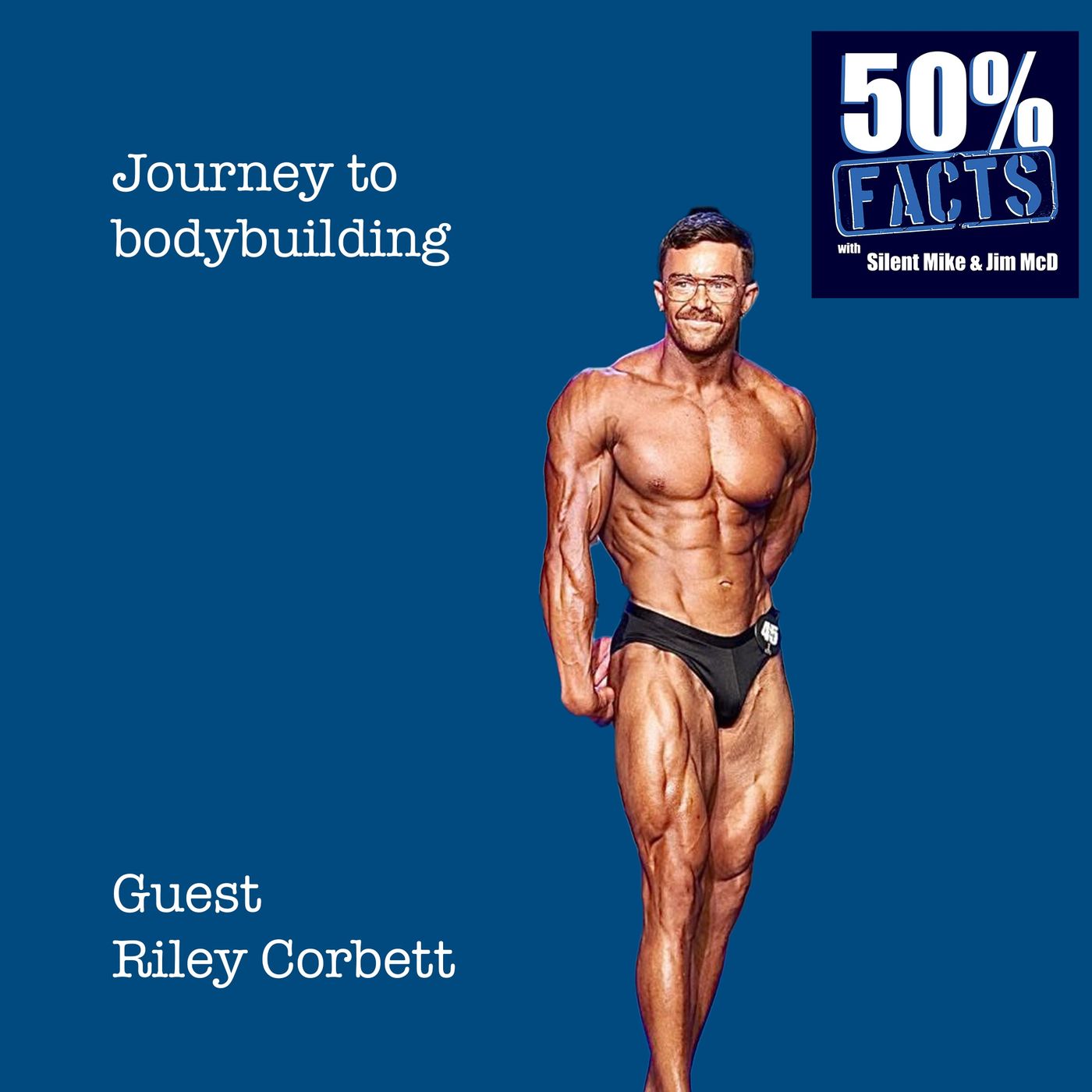
Journey to bodybuilding | Guest: Riley Corbett

 Apple Podcasts

 Spotify

 Goodpods

 Audible

 iHeartRadio

 Podchaser

 RSS Feed

 Castro
Unlike some powerlifters who turn to bodybuilding, Riley always knew it was something he wanted to do. Other goals and priorities simply got in the way. When the opportunity came to leave construction work and retail management for personal training, he jumped in with both feet. Riley is our head trainer at Third Street Barbell. He shares the story of his journey to the stage in this episode.
You can find Riley on Instagram @riley_corbett https://www.instagram.com/riley_corbett/
Join our Discord for free at goodcompanydiscord.com!
Check out our gym (Third Street Barbell) at ThirdStreetBarbell.com https://www.thirdstreetbarbell.com/!
Check out our podcast website: 50percentfacts.com https://www.50percentfacts.com/
50% Facts is a Spreaker Prime podcast on OCN – the Obscure Celebrity Network.
____
Hosted by Mike Farr (@silentmikke) https://www.instagram.com/silentmikke/ and Jim McDonald (@thejimmcd). https://www.instagram.com/thejimmcd/ Produced by Jim McDonald Production assistance by Sam McDonald and Sebastian Brambila. Theme by Aaron Moore. Show art by Joseph Manzo (@jmanzo523)
Become a supporter of this podcast: https://www.spreaker.com/podcast/50-facts-with-silent-mike-jim-mcd--5538735/support.
0:09 Because I've been recording several episodes in a row here, and anybody who's paying attention to the sound of my voice may realize that it seems like I've probably had a cold for about a month and a half of episodes, which is really just like a couple of weeks. But it just does not want to go away. I and and like the thing, this is my third round of just having constantly blowing my nose of the of the whole thing. It just just and I never get cold. It's probably been a good decade since I've had a cold, and this one just will not entirely go away. I heard this. Year the allergies are like next level for everybody. Yeah, and I haven't got them since I was a kid, And this is the first time where I've been like bedritten, just like stuffed up and just like feeling disgusting.
0:51 Well, I typically couldn't tell you the difference between like a cold and allergies, but like I gotten to the point where this this was definitely a cold. It's like I had throat and it's just like coughing, and not that you can't know you can't not that you can't get coughing from from allergies, because you sure can people particularly have asthma. You know, do you have asthma? Now I don't. There was a time in which I thought that. I did sports induced or whatever I had. I had some kind of reactive airway syndrome, and that I had no idea where exactly where it came from, except I had like gastric reflex at the time, and like my sleep avenue was just getting diagnosed or whatever.
1:34 So I think my airway was just like super irritated. Was this back in powerlifting with the back in the day with gear and everything so pretty heavy? Yeah, there was that. And I had another instance where my son and I pulled down a shed in the backyard and I just like flooded myself with with a like dry mildew, and I, like Scot said to it, So that's kind of like always had year round allergies, but now they really have here around allergies, had allergy shots the whole nine yards. It's like, you got better. I can live with it, but it's not fun. Yeah, just sound a little funky for a while. Yeah.
2:15 Yeah, I'm here today with Riley Corbett, our our head trainer, here at at third tree Barbe. Riley's been around us for a long time. How many, like over ten years or probably over ten years. Yeah, you were you were in Mike's class. Yeah, yep, Mike and Marcus. Here or at the west Side. And west Side, yeah, the second one after this one. Okay, Yeah, so I was over there and uh yeah, started training with everyone, and then eventually it just started coming in more and more and started lifting. And I have to say that you look dramatically different now than you too. Yes, back then, even five years ago.
3:00 If I get really ambitious, I'll throw a picture up, but I probably won't because you were. You were in a couple of photo shoots when we started the apparel line when we win, like even before the gym opened, and it's like you were pretty chunky. Yeah, definitely pushing the bulk back then. I was getting into the strong man stuff. I pushed my weight pretty hard. So I was in the two fifties when I'm only five eight, So it's yeah, it was pretty chunky. But yeah, definitely lost a lot. You're only five eight, you always look taller to me. I appreciate it. I'll take that one. I can get it. How told you see bass uh, five eleven Okay, yeah, seeh I believe that, but I don't think in my mind, I don't think about you being dramatically different heights the two of you.
3:44 I'll take it five to eleven, then we'll take it. Yeah, I would take it. You know, I used to be like over five eight, you know, like five eight and a half ish whatever, and I'm five seven because I'm old number one and just like the squatting oh yeah, just like compresses your disco discs. Yeah, no space, no, no whatsoever. So was where you are now? You're you're actively competing in bodybuilding? Now was this always the goal or so? Yes? And no. The whole reason I got into working out in general was you know, to look like a bodybuilder, and you know everyone wants to be more jacked and all that stuff.
4:26 So that was my initial focus. Was I was training just you know a lot of hypertrophy, you know, six days a week in the gym, still kind of eating whatever I want. So I was, you know, eighteen to twenty something, so I could get away with that kind of stuff, and I wasn't putting on that same weight. But the older I got, and then I started switching into more kind of you know, after those first couple of years, those newbie gains die out, that bodybuilding training is a little less fun. So I kind of had to switch my focus into some strength training to kind of keep my progressions going and kind of liked it. But then at that point it was like, Okay, do we stay the same size or are we going to try to push those lifts a little harder. And that's where the weight gain came. From, just constantly chasing those next numbers up and then you know, just kept going.
5:10 So I just kept rolling with it. Yeah, And that was at the time too, that was actually very that was still pretty common. It was yeah, the whole the main gaining and all that wasn't a thing back then. It was bulk, get as big as you could, get huge and. Live your life. Yeah, I mean Dave Tate was talking about people, you know, eating sleeves of oreos and butter and just like all sorts of things in order to put on weight. Yep, my posts workout four times a week. When we were training out there, I'd go because we had that in and out right around the corner. Oh yeah, so I'd go right into the parking lot get my two four by fours animal fries, eat that in the car, and then I had about thirty minute drive home, and then I had my beef and myron, my rice and all that stuff after. So it was a constant just eating twenty four seven whatever I could get my hands on.
6:02 Yeah, like any idea how many calories that was versus how many you're you're consuming now. I always estimated it at around like four to five thousand, but uh, you know, now that I've been you know, more focused on this bodybuilding stuff last year, I pushed my off season to about almost like five thousand calories, and uh, you know, the amount of food I was eating was definitely twice as much as I was eating before. So it sounded like it was a lot. But I don't know if I was just eating. So much, you know, fatty foods and stuff, and I was just getting a ton of calories, but it sounded like a lot more at the time. Yeah, it was maybe this composition of those glories of for sure, it was. It was the issue, for sure.
6:46 So when did you make this switch? So right at the beginning of COVID, I got a colon infection. So the colon infection came on like out of nowhere, and just one day I woke up felt a little sick, decided I would go to the gym anyways, did some squats. I think that day we were repping like four sixty five or something, and made it through the whole set fine. The end of the workout, I was just not feeling good. So that night I went to the hospital and I couldn't pee or go number two, so they thought I had an inflamed prostate. So they put me on some antibiotics, had me go home, said if it didn't get better, and like two days, come back two days later. Still was just getting worse and worse.
7:35 But at that point, you know, I'm a stubborn dude. I was, you know, mid twenties. You know, I'm not going to the hospital twice in three days or whatever. So I kept saying, I'm good, I'm good, just waiting, waiting, and you know, that fever just kept creeping up, creeping up, and then got to the point where I was, you know, over one hundred and four, and I was the girlfriend I was living with at the time. She was like, we're gonna call an ambulance if you don't get your ass to the hospital. So she called my mom. My mom's calling me freaking out, and so ended up going to the hospital again. And by the time I got there that time, I was in bad shape, already going septic. So it was like, shit, got really. Am I allowed to cuss on here started getting really serious really fast, and then so yeah, everything just kind of came out of nowhere. So I had to have emergency surgery. And then after that it was like no lifting for a while. So at that point there was no real, you know, reason to try to keep being big if I wasn't going to be lifting heavy. Yeah, so that kind of started the process where I was kind of controlling my food a little bit more, and then I started getting back into the swing of things, started pushing it a little more, and then I tore my latin here dead lifting like five eighty five. And then, you know, after that, I was like, you know, let's take a break, reassess what we're doing, because I can't keep taking time off work for injuries like it's you know, it's it's not a realistic thing. So I had to kind of change focuses a little bit, just started kind of cutting down, and once the fat started coming off, I realized I had a decent amount of muscle underneath.
9:06 So it was like, all right, let's see what we can do now. So that's kind of how the whole bodybuilding thing got started. That's interesting because you don't even like physically, don't even look like the same person at all. Like I can't even I can't even you know. I think now I walk around at I mean, right now I'm a little leaner because I'm cutting down before I push up again. So I'm about one ninety right now. So that's you know, sixty pounds difference is pretty pretty noticeable. Pretty significant, Yeah, for sure. For sure. Who did you look to for for information when you made that shift? You know what? Honestly a lot of it was just you know, stuff on the internet.
9:49 You know. I've been you know, in the game for a long time. So throughout the years, I have manipulated my weight, you know, competing and you know, I would I think I've done one eight, one ninety eight, two twenties, and two forty five. So throughout that time, I've kind of had a pretty good understanding of nutrition and how to kind of change my weight to where I needed it to. So from that point it was just kind of like researching a couple of nuanced things of how I can really dial that in for my performance, because you know, once you get into the whole restricting calories, it's all pretty straightforward from there. Yeah, So once I kind. Of had that dialed, it was like, how do I really kind of step it up another level, make sure I'm getting the nutrition I need to really kind of fuel my training and kind of make that you know, next level change.
10:35 What is what is your current program look like versus what you used to do. So, like back in the like powerlifting and strong man stuff, I would usually only train about four days a week, and those were obviously going to be super long sessions just because you have so much to do, you know if you're squatting, benching or you know, doing your log press, sandbags all that stuff, So training for two or three hours of session, so you're definitely getting in a lot of work, but it's not the same. So my initial focus was trying to get into the gym more and just try to you know, not do as long as workouts, but just kind of little stimulate and kind of get out at first and then once I kind of adapted to that, I kind of started adding more and more volume, and then it kind of became a thing where how can I get in like the most amount of volume I need per each body part while still being able to recover. That was my biggest problem when I kind of first started this whole stuff. I'd, you know, try the bro splits or like a push pull legs, but you know, it's if I'm doing too many sets throughout the week. I noticed, you know, when I come in three days later, I'm still not able to kind of move the weight that I really needed to. So kind of finding that balance for how much volume I can actually handle throughout the week and still feel good for my next training session, that was kind of the biggest determining factor. So now I train about five to six days a week, but my workouts are a little bit more condensed. I'm kind of just getting after it the whole time.
11:59 Shorter rescip. Yeah, just kind of more you know, basic stuff, kind of more what you just see like bro kind of you know, bodybuilding stuff, pretty straightforward for the most part. What are your your favorite lifts. These days? These days, I kind of just go with whatever feels really good, So it changes from you know, month to month. I think right now, I'm really into like, uh, you know, like certain flat machine presses that are converging, and yeah, you know, certain pendulum squat machines feel really good. But you know, I'm more about just whatever I can kind of feel the best and comfortably move weight. That's kind of ends up being my favorite things now on not about you know, what I move the most weight in and what looks the coolest.
12:49 How I mean, how individuals do you think it is? I mean, do you do you think that you can like not that back in the day when when when workouts were published in bodybuilding magaziness, not that you could rely on that being the thing that the person actually did. But how how possible it is just to take an off the shelf program and get where you're trying to go or is that just like step one toward figuring out what you actually need to do? So I'm like personally under the belief where like I think, whatever, like you whatever you can kind of push yourself towards, like you know, you you are your own kind of limiting factor with this kind of stuff, because I mean the biggest thing is how hard are you going to push it? Because you can give you know, ten people the same program and they're all gonna get, you know, pretty different results. But at the end of the day, you're gonna notice that there's gonna be you know, three or four people in there that are probably pushing at a different level than everyone else. And I think that's gonna be the biggest determining factor is how hard you're actually trying in those I think a lot of those programs that you can just find off the internet, probably for eighty percent of the population, they're going to work great.
14:02 But the real kind of thing is like how hard are you actually trying in those workouts? Yeah, because it's it's really easy to go through the motions, but are we lifting with intent? Are we actually trying to get better every session? Those kind of things mm. Hmm, Yeah, that makes sense. Who are you working with at this point? Like what kinds of clients are you working with right now? I have a pretty giant mix of kind of a little bit of everything. I got, you know, clients in their eighties, and I have clients all the way as low as you know, eleven years old. So wow, got a pretty big range kind of working with anybody. So whatever people have problems with, we can usually get them sorted. But what, obviously a parent's going to be involved and within eleven year old one, what what's the goal there?
14:44 Is it a sports thing or is it just a getting better shape thing? Or well? Well, now what like a lot of it is now it's a lot of these kids just aren't playing sports. So now that they're not in sports, you know, they're just playing a lot of video games and they're not getting outside. So a lot of parents now are just taking the initiation to be like, hey, we're going to put you in personal training, get you at least move in a couple of times a week, just to get you on that path. I think people are starting to really realize now that there is a lot of importance, you know, staying moving and actually getting that exercise in. So if you're not going to be playing sports, we got to do something. It's funny how the pendulum swings, you know, because they're there for a while, it's like, well, I mean we all know that that that school's cutting out like pe and sports and stuff was a bad idea. And at the same time we have this huge rise in the diagnosis of ADHD. And it's like, well, you're not giving kids anything to do. They got to run around, that's I mean, right, they've got you've got to burn off the energy somehow. And yes, it's it's great to see that a parent would recognize that, hey, you need to get up off the couch. That's it seems like such a cliche, but it's like true, it's it's it's sad true.
16:01 And actually, you know, use your body, create some physical effort beyond what you're doing with your thumbs and you know. And it's a you know, it teaches them that, you know, they are capable of more than they think. That's the biggest thing. Yeah, that's I mean, yeah, I would, I could see. I can see how that would be a big deal because it is easy to It seems like there are sort of two mindsets and not just kids, but like people period. Either people think that they can't do X, or the other people who think that if they just did X, they might be really good at it. And they might be, you know, like and and there's an ego weird thing there. They might ever actually do it, but they think that would be good if they did.
16:41 And yeah, Yeah, that's definitely definitely a thing too. Yeah, that's the thing that we all deal with it. And then you're working primarily with clients in person. Yeah, I do some online, but for the most part, most of my clients are in person. Right now. Yeah, you've been giving me stuff to do and it's been getting me back into it. But I had this conversation with somebody the other day about whoever they were working with, and like, yeah, what do you get this After a while, after a few weeks, you start thinking, well, not that I know more, but I want to do this differently. It's being done yeah, and not you know, I mean, not that there's anything wrong with it, but it's just like, well, I'm used to maybe heavier weights, and I can't do those heavier weights for ten for a set of ten. I can do them for five, but I can't do it for ten. And it starts to morph and and I guess that's sort of a natural process too.
17:41 Yeah, everything's gonna always change, you know, your training is not always gonna be the same throughout your entire life. You're gonna have different flows of things. Yea, injuries are gonna come, life events are gonna happen. You're gonna have to switch things up, and the more you can adapt to those things, the overall better off you're gonna be. Yeah, you know, I think that that's true. You know a lot of that too is you know, if you can just stick to those kind of basic things. A lot of people get into that, you know, habit where they do want to change those things that their coach gives them. But then, you know, if you're constantly changing everything so often, there's no way for us to track progress, right, So, like we do need to stick to those things for a long time, and people don't like that, and I know it's kind of boring at first, but it's that kind of discipline of doing the same thing over and over and over again that's where we really get better.
18:24 Yeah, For me, Like, i know I'm going to be out for two and a half weeks or so, and I have no idea about whether I'm going to actually how often I'm actually going to get to a gym, And historically, like I haven't really worried about it too much, but because I've been kind of back on a role lately, Like you don't want to keep that momentum yeah, you want to keep the momentum going. It's not like, oh my god, I'm going to lose all my games. But in a way, it kind of is, you know, you don't want you don't want to like fall into that cliche, but at the same time, like it's a habit and you have to, like you have to keep the happening, you have to keep the happy, you have to keep it in the groove. And that makes it, you know, disconcerting when you just can't can't do it.
19:10 Yeah. Yeah, it's just so so we'll see what my mental state is like script I managed to accomplish and just time to like this is like I'm traveling and I'm going to feel like shit for the first couple of days. Yeah, because I mean you're going to be moving, so it's not like you're doing nothing. Yeah, so exactly exactly. It's just it's not what I'm not I'm used to, just totally out of the routine. Yea, how were you What do you feel about step counts? On it during the day with with clients, what do you what do you tell folks? Yeah, I'm huge on steps, so you know, getting in those at least you know, ten thousand steps a day. We can burn a ton of calories that way. So even throughout most of my cutting, I mean, I'm down, I think twenty five pounds or so down on this cut right now, and I haven't done.
19:58 A single day of cardios. So I guess my ten thousand or some days I'll maybe do twelve if I need to burn a little extra, depending on how my weight loss is going. But yeah, I keep it around ten or twelve thousand, and I usually know with that amount of walking, I'm probably burning around four to five hundred calories a day just for my active movement. So at that point, you know, that's you know already what I'm gonna get more out of that than I am thirty minutes on the bike. So yeah, it's a lot easier to do that way if I just take a couple, you know, ten to twenty minute walks throughout the day after my meals and just keep it easy that way. I have to say that I have lost any fascination I ever had with walking on a treadmill. I will do it, but I have it's like, oh my god, Yeah, it's it's a slog, whereas like walking outdoors is not a slog.
20:43 No, it's way easier, way easier. You get to, you know, change the environment. See a little bit visual stimulation. That's huge. The temperature isn't always better, but some. Yes, that's why I during the summer months, I got my walking pad, so I just kind of throw it in the corner of the living room. I pull it out right in front of my TV and just do like ten to twenty minutes while I'm watching TV. Then park my ass back on the couch. You know, at least get a little bit of movement if I'm going to be just kind of hanging out all day. So when it's one hundred degrees, I still try to get it in. So you were you're working in construction before, right, Yeah, and then you shifted to training, Like how did that happen?
21:25 Was that? What was the Yeah? So I got into doing construction right out of high school. And then when I was in my early twenties, me and my younger brother we started our own construction company with our dad, and so we did that for years. But during the whole time of the colon infection and everything, I wasn't allowed to lift like more than fifty pounds for like six months or something like that. So construction was one hundred percent just out of the question at that point. So I kind of had to pivot and figure out what I was going to do to you know, get money in my pocket. So I was managing a couple pubs and stuff for a little bit, but I just you know, wasn't the move. Didn't enjoy it at all, So I.
22:07 Could see how it would be a pain in the ass. Yeah, pain in the ass dealing with drunk people and you know, upper management was terrible. So it's like, get out of that, trying to go back to working for myself. And then it was like all right, I already knew that training something that I'm passionate about. I love bodybuilding, I love powerlifting, I love helping people. So it was kind of just like a natural progression that like, this is what we know we like doing. Let's see if we can try to make money doing that. Yeah, you know, so that's kind of how that kind of went about. Yeah, did you did you do SERTs or did you? Yeah? So years ago, probably mid twenties or so, I went through the whole NASSAM certification to do all that, and I was going to start start training, but I just never wanted to kind of pull the gun and just actually start doing it. It was kind of always one of those things with one day I'm going to do it.
22:58 One day, I'm going to do it. And so he finally was just like, all right, it's the time we got to do it. So yeah, But other than that, it was just you know, my basic certification, and then I'm constantly trying to soak up whatever information I can get, so, you know, constantly listen to more podcasts, you know, reading studies, you know, trying to figure out what's the new information out, what's working, what do we know that's not working anymore, you know, all that kind of stuff. So you're you're obviously, like, like like every everybody who's getting started in bodybuilding, you have like a goal in mind, and most of the time the goal is a pro card, Right, what's the what do you feel like the mental prep is around that for you?
23:46 So for me, I try not to I mean, obviously that is the end goal. You know, I'd like to, you know, get that pro card and establish you know, if I could actually step on stage as a pro and see how I hang with some of the best guys out there, and you know, that'd be awesome, but I try not to put too much pressure on that kind of stuff, take it day to day, show by show. So my first goal was just to step on stage. And you know a lot of people have that goal of just stepping on stage, but I wanted more than that. I wanted to not just step on there and just do it. I wanted to, you know, look like I belonged up there. I wanted to look like a bodybuilder. I didn't just want to show up and get my participation trophy. I wanted to go in there and you know, show that I belonged. So that was my first goal, is I tried to just go in there and just bring my best look that I possibly could. And then after that, you know, it kind of showed me that I do kind of have the structure. You know, I brought in you know, super lean physique, so you know, I think I could probably do it. So that was just going to be keep trying to level that up and just see what we can do.
24:47 I feel like, you know, in power lifting all the time, we see people who were just getting started or whatever who were reluctant to commit to being in a meet because it's like, well, I do want to wait till my lifts get better or whatever whatever. And in powerlifting that is totally not. The right choice, completely opposite. But in bodybuilding it is the right choice. Here, I think I think you're making a good point. It's like you want to you do you want to go out and look halfway legit at least right. You want you want people to be able to not and say, oh, okay, I get it. I understand why you're why you're pursuing this. Did you go to bodybuilding shows before you started being in them?
25:29 Actually no, so never been to one before, and it was quite a culture shock, coming from only being in powerlifting meats before, where it's just you know, you know, chunky tatted dudes eating candy all day, smelling like Ben gay and stuff. Then you go to a bodybuilding show and it's just completely different. You know, everyone's pretty closed off, you know, no one's really talking to each other. It's it was quite a different you know, vibe on everything. Yeah, it was, you know, I had a good time, and you know, it was it was definitely an experience for sure. But I always tell everyone and the people you meet at like powerlifting and strong man events, they're going to be like the most genuine coolest people ever. Sometimes you'll get some cool people in bodybuilding too, but I think it's a little bit different of a crowd, but you know, it's a little different. But yeah, it's definitely a different between the two for sure.
26:17 It's Yeah, that's interesting that that that that kind of level of camaraderie doesn't really happen as much. But part of it is just like people are maybe more in their head. I think, so, yeah, there's I think there's a lot more of a mental aspect to bodybuilding, just because especially in that last little bit, you know, you you're starving, you know, you're miserable, you don't want to be there, you want to get food. So I see, you know the the reason behind it, for sure, But it is a totally different vibe when everyone's at a powerlifting meet. You know, everyone's pretty, you know, happy, go lucky, you know, kind of relaxing. But it's different out a bodybuilding show.
27:00 You tolerate the tanning part of it. It would just drive me nuts, Like I don't like anything on my skin in the first place. That's the worst part of all of it. You gotta go and go in a room with like ten to twenty other dudes. You're just sitting there naked, and they got to get all up everywhere, spray you head to toe, and then you gotta dry off. They're all sticky and gotta go back to your hotel or your house. You can't shower for that night, so you'd be all stinky. And then it's real gross when you go the next day and then you're posing on stage, just sweating into that stink, and it's gross. It's terrible. I hadn't really thought about that that. That totally makes sense. Because once you get that tan on, you can't shower, You can't put anything on your skin, so no deodorant, no nothing, And yeah, everyone's stinking real right back there.
27:43 It's gross. Good lord, it must be like it must be like the County Fair. Exactly, going to the four age area. Yeah, everybody smells like sheep and goats, cows, horses. It's crazy. Yeah. In terms of you know, we talked about a broad range of clients, like what are your favorite kinds of clients to work with? So for me, my favorite type of client is anyone that comes in and just gives me one hundred percent. Yeah, if you come in, you give one hundred percent, no matter where your fitness level's at. I can tell if you're giving me one hundred percent. It's pretty easy to tell. If you know, if I can see that you're really struggling, or if you're not breaking a sweat at all and you're talking the whole time, we can we can tell.
28:29 So you know, if someone's in here and they're coming every session and they're giving me everything they. Have, those are my favorite. And that's the most I can ask for, is you just put in one hundred percent of the effort to the you know, the program that I'm going to give you, and just trust that it's going to do the results. And then you know that those type of people are always the ones that are going to have you know, the most progress too, so it's kind of you know, they end up working the hardest and they kind of get that validation after, so then we both kind of feel better after. You know, you would think that the money would be a real motivator so that people would like stay on track and know. You would think that you'd be surprised. Yeah, I guess so it's like I guess psychologically, sometimes paying the money sort of checks the box for some folks, you know, and like you pay the money and show up, but you don't really necessarily emotions. Yeah, you don't feel like it's required that you like really really push yourself. Yeah, And I think that it's unfortunate, but it's.
29:29 It does happen, for sure. I mean, I do have my clients that I have some clients, especially at my commercial gym that I train out of. You know, they pay their money. They come in once a week and that's the only time they touch the gym, and they think that's going to be enough. But you know, at least we're getting in one day, but we should for sure beginning in more. Yeah. But you know, one's always going to be better than nothing. So you know, we got to get you doing something at least. Yeah. Yeah, and age range or doesn matter, you. Know, for the most part, it doesn't matter. I've had eighty year old clients. I have one of my clients that she actually just you know, she's going off doing her own thing now, but she was with me for maybe six to eight months.
30:15 Her name was Miss Susan. If she listen to this somehow she's awesome. But yeah, she would come in twice a week, and you know, she'd get after it, and you know, it went from her barely being able to you know, get on and off up a box to where she was squatting with you know, fifteen pound dumbbells, you know, just completely change how she moved throughout the day. And you know, when you hear those things of a client being like, you know, I'd always had this problem when I get off the couch and it takes me forever to get warm, and my knees hurt all the time. And after a few months where they're telling you like, hey, you know, like everything that I'm doing nothing causes me pain. You know, everything feels great. You know, I'm carrying all my groceries by myself. You know, that's an awesome feeling. And so like when I hear that, you know, that always just kind of validates everything. So it's always the clients that you know, get the most where you know, obviously I'm gonna have a little bit more kind of bias towards those ones because they're obviously working a little harder, you know.
31:12 Yeah, yeah, And I mean strength gives people agency, especially as you get older. You know, if you're if you're strong enough to be able to do things yourself and you don't actually have to ask for for help all the time, even. That independence is huge as you age. So yeah, yeah, speaking of someone who's getting old, I do occasionally ask people to do things for me that I don't want to anymore, usually involving ladders, having fallen off a couple in the past few years. Yeah, I just yeah, yeah, no fun at all. Something you and I have talked about reasonably extensively offline is UH, clients on GLP one agonists. How what have you observed in with those kinds of clients.
32:03 So from the things that I've noticed, those GLP ones, they're a great tool to add to our diet and training that are already in place. But they're not gonna be like a magic thing that everyone is anticipating. You're not just gonna take that shot and lose fifty pounds in three months and then gonna be a completely different person. There's gonna be some type of lifestyle changes that are gonna have to happen in that we're gonna have to do something differently. So a lot of those people that. You know, I do have some clients that get on these GLP ones and you know, they're really reluctant to change the way they eat, and you know they're so one of the biggest problems is you're gonna have that you know, your gastric empty and is gonna slow down.
32:45 Your metabolism is gonna run a little slower. So all that food is gonna definitely make you a lot fuller for longer. And what a lot of people do is they'll have, you know, a tiny little protein bar for breakfast, and then for dinner they're having a salad, and then they had five hundredalaries for the day. And they think they're good because they're you know, not hungry. But then the reality is, okay, well, now that we're jurassically so under our calories, our weight loss is not just going to be fat, it's going to be muscle as well. So a lot of those people, they're you know, not having the weight loss that they expect to have because they're just not making sure they're being fed properly. Yeah, that's the biggest issue that I see. I mean, I've had clients lose eighty plus pounds with them so they definitely work, but they do need to be used a little bit responsibly.
33:30 Yeah, I mean, I've been this is sort of a bit of theme lately, but I find that a lot of people are that's really weird. The wind or something. I have no idea, that was a little little earthquaky thing. I don't know, know. The lights aren't moving, so it's not that I don't know. I'm not When I move it doesn't bump the monitor. I don't know what happens are they're just being given these drugs. My analogies like people depressed people getting any depressants but without any any emotional support, talk therapy or anything like that. That doesn't make sense to me, but but it's it's kind of more common than not. And I think that that's happening with the GLP once too, where they're just not getting the the lifestyle change support. And you know that the worst thing isn't isn't the idea that you might stay on the drug for the rest of your life. You know, whatever your the drug is. The worst thing is that you have lost too much muscle or your your diet still sucks.
34:43 And so when you're still taking this drug for no other reason. Yeah, for no other reason, the fact that your diet sucks. Yeah, it's just you're just taking it so that your your diet can be terrible. And you know, I try not to be super cynical and you know, get into my conspiracy theorist mind about you know how much of that is the you know, pharmaceutical whatever just pushing those drugs onto people. But every time I watch TV, I think I see about five different commercials for different GLP ones and stuff. So it is crazy. You know, they do work, but they definitely need to have some responsibility to them too. Yeah. Yeah, and everyone is just looking for the quick fix, the quick fix. The thing. I actually I saw this the other day. This is just in terms of like revolutionary drugs that UCLA has developed this molecule that reawakens hair follicles, so it's essentially a cure for baldness.
35:44 There we go. It's like wow, like in I mean, I don't know how long it's going to take to get like f they approved for this, but in like five to ten years when we when people are bald, it's going to be by choice. Yeah, Like what in the same way that you know, the the GLP one and what's the other one, the other hormone that that is in like uh agonists that they use in like zip bound and that's the grellin Yeah, g IP. Yeah, g i P and then yeah, some of them will I think it's the I think that's the redit true tide. Does the g IP, the grellin and the g LP one or something, So yeah, it does like a triple agonist on it.
36:29 As these drugs improve, that's where I was. As these drugs improve, then maybe just being fat will be a question will be a decision as well. I mean, well, yeah, they have those myostatin drugs that they're starting to run through some phases now that I mean seem pretty promising in animal studies, but I mean you never know with humans. But I mean, if you can get a you know, myostatin and hibberw that just allows you to build muscle without doing anything, and then you have some advanced GLP one that melts the fat off you in the future, I mean, there's probably gonna be a drug that just, you know, ten years where you just put on muscle and burn fat while sitting on the couch. It's you wonder about the the physiological effects of that, because, like I mean, people who who take steroids, sometimes you find that they muscle growth way out strips the ability of their their tendons and ligaments to keep up, and you start popping tendons and having surgeries and reattaching things and one thing or another. I wonder if that'll be the case.
37:38 I'm sure it will. I'm sure there'll be some type of new problem that we'll see with you know, stuff happening. There's always kind of a it's always kind of a zero sum game, you know, where you know you. Can take for something. Yeah, you're not just gonna get a free ride to getting skinny and jack with nothing. Which sucks, because that'd be great. Yeah, that would be awesome. I I am always amazed by I mean, the people still still use the the morphology, you know, the three classifications, you know, the metamorph and morph Yeah, all that stuff, because it's really it describes something, but it doesn't mean anything at the same time, but there are people who just don't put on weight, either muscle weight or fat at the same pace as everyone else, and and that's frustrating.
38:41 But those people are are often frustrated because they're not putting on on muscle. But then at the same time, you know, from my you know, from what I've seen of you know, doing this for a long time, there's so many of these skinny guys that say they can't get bigger. They're really reluctant to really try. To push the food. Yeah, and at the end of the day, we can't get bigger if we're not going to eat. And I know that's super counterintuitive to what the Internet says nowadays because there's that main gaining stuff. Or whatever that is. I don't even know what that is. Yeah, it's basically guys just try to eat at a maintenance level of calories and try to make gains that way so they're not putting on fat. But I mean so like a kind of like I don't know, like a worsk thing.
39:26 Yeah, maybe, or maybe just like a super tiny deficit where they're not going crazy. But I mean, at that point, what are you gonna do, like do that for two years to see any type of progress? I mean, what are we really doing here? You know? Yeah, in terms of progress, like how do you deal with I'm sure it happens for strength, but I know what happens for weight loss. Where people are just getting stuck. They're just not not not progressing at the speed that they want to, or just don't seem to be progressing at all, Like what do you what do you say? What do you wit your council? So there's a there could be many different things. You know, for some people, it could be as simple as maybe we just get in some more steps. So for a lot of people, you know, if they are kind of exercising more, that getting in that step count might be the last thing that they're going to do. So the first step maybe just getting into the gym three times a week. So you know, if they're getting into the gym three times a week, you know, we're doing something at least, but we're still not burning those kind of calories throughout the day in the week that we need to.
40:26 So for some people, just kind of getting in those extra steps throughout the day might be able to do a little something. For some people could be you know, stress related, what's you know, your sleep looking like for their stuff like that. There's a lot of different nuances that can come into you know, stalling with your weight loss and progress. But a lot of it is going to be kind of person to person individual on what kind of stuff they have going on in their lives and stuff. Yeah. Yeah, that's I mean, not making progress is a big reason why people quit doing things. Yeah, you just don't have the feedback loop. Yeah, and that's why it's you know, important to have a trainer or a coach or someone who can give you that feedback and being like, Okay, well if this isn't working, now it's time to pivot. So like you got to always kind of you know, know what the next move is gonna be. And if you don't have that knowledge yourself, you're gonna just keep hitting those plateaus.
41:17 Yeah. And I mean, obviously it isn't always about scale weight for sure, and you just you most people are not checking in on their lean mass versus body fat on a super regular basis and this or at all, and that the scales that use impedance are just not very accurate, and you know they can be. Yeah, you can get like a ten to fifteen percent variance on some of those. Yeah. Yeah. And and I don't know the last time I saw anybody have calibers used on them. Yeah, I. Know. And I still have a set from the from the like late nineties at home somewhere. They were kind of cool because they would like they would snap when they gotten Yeah. Yeah, well that's sort of I mean, that made sense to me. But it's hard to do on yourself for sure, and.
42:10 It's paining the ass to do on other people. They don't like it. Yeah, yeah, no, sure. So it's like you know underwater way did that a few times back in the day. Yeah, now they got the decks on. I've done dex that. Yeah, And and DEXA is like, I mean, the underwater stuff is not painless. The dex is painless. Yeah, the underwater is probably gonna give you a little bit more accurate read on it. But that's what I'm saying. You don't have to dex that. You just lay on the. Table super and it tells you, like where you're, where you're, It gives you a full X ray all that, where you're, where you're, where your fat is stored, and you know whatever. I was talking to friend last night who was saying that his his gym did a big like ninety day fat loss challenge.
42:58 It's happened a lot right now the summer. He's skinny guy in the first place, but he you know, he dropped a fair amount of weight. I don't know how many pounds it was. But then he went in and got a dex and it's like, oh, all, nearly all my fat now is visceral. Yeah, I'm over fifty and you know, full of visceral fat, and that getting rid of that is just super challenging. Yes, I don't. I mean, there are they talk about, like the stubborn fat loss protocols around like it's like hit and this, that and the other thing to try to get get rid of that stuff. And I mean, I don't know.
43:42 I mean, that's that's really my demon and has been for a long time. And I don't know. I don't know what because I'm you know, the process of losing weight currently, I just don't know like where I'm going to land and how bad that's going to be. I will go back and get another Dexa and see where that stands. But like I had, I had one a few months ago, and I hadn't had one for like seven or eight years, and what had changed during the time was that, you know, thirteen extra pounds of fat, my lean muscle moss was exactly the same. There you go, But it was all just fat. Well that's that's fun at any muscle that's good.
44:23 Yeah, yeah, probably, Well I was, you know, it was also heavier. I was, you know, about thirteen pounds heavier. So I just gained fat. Apparently that's uh, you know, unfortunate happens, unfortunate fact of life. Yeah. Yeah. Do you. Have you had clients like leave because of like circumstance whatever, you know, work or life or whatever. Sure, yeah, that's usually people's first thing that you know, personal training it is going to be a little bit of a pricey investment. So a lot of people their initial you know kind of qualms about everything is that kind of payment. But you know, I try to be pretty affordable with people and work with people where I can.
45:09 But you know, if we're gonna say we're gonna spend you know, three hundred dollars a month on personal training, if you go out to the bar, you know, three weekends a month, yeah, you're easily gonna spend three hundred dollars if you have going out with a girl or something else. You know, that's only a few drinks, that's you know, the short night, you're gonna spend a hundred bucks especially if you've got to pay twenty bucks to get in somewhere. I mean, so I try to always tell people that if this is something that we really want to do, and if this is a really important goal to us, that there's gonna have to be some sacrifices that we're gonna make somewhere else. And so if we can make those. Sacrifices towards something that's only going to be putting us into a you know, worst direction, like going out spending twelve dollars a meal on fast food three times a week, or you know, going out to the bars on the weekends.
45:55 Cutting out those things right there and just kind of reallocating some of those funds to something that's gonna, you know, improve your quality of life is kind of the biggest kind of how I try to let people see that. Yeah, Yeah, And then have you had circumstances where people have sort of left, like fallen off the wagon and then come back. Yeah, For the most part, I try to keep people with some type of guidance. So I always tell my clients that the more times that we're in together, touching bases, getting face to face, like, the overall better progress we're gonna make and then as we progress, you know, we don't need to be you know, doing that face to face as much. The more they learn in the gym, the more comfortable they are doing stuff on themselves. But it's still good that you know, we touch base, you know, at least once a week to check in and be like, how's it going, you know, is there anything we need to change? You know, how's your week been? Like, are there any things that's happening differently? And so that way you always have that feedback to where you know, they can always keep something to where they're still moving in the right direction. At least I try not to have someone completely go away and then try to come back, because then at that point they've probably regressed a little bit.
47:11 Yeah. Yeah, it's amazing how fast, like if you've been committed in the past, how how fast things will come back. But it but it sucks because you you you always have to end up starting it at like ground zero again. But muscle memory is a real thing. Muscle memory is a real thing. Yeah, it's just it takes a little bit of consistency to kick back in. Yeah, for sure, I have a a couple of like just like food related questions. To wrap things up, one of everybody's biggest challenges is just getting enough protein. It's it's people people who have no idea how much protein that they need. Uh, and most people are just not getting enough number one and number two when people actually trying to get it, it's it is challenging. Yeah, it's probably one of the bigger challenges. What what what do you do?
48:03 What do you what's your life? So what I always want to do for most people is I initially want everyone just to start off with just tracking what you eat normally for a couple of days. So when people initially do that, you can probably see right off the back that their protein is going to be a little bit lower. So one of the first things that I try to do for clients is I don't try to jurrassically change calories or anything. I just want them to focus on eating more lean proteins throughout the day. So for like a breakfast, I try to have them focus on, you know, either like a Greek yogurt, way protein, some eggs, something like that, where they're going to be getting a good hit of protein in and then for lunch or dinner, we're going to be doing like a beef, turkey, chicken something where it's a lean protein like that, and then I try to have them do that at least three or four times a day, and then throughout the day in between, if they're in their car driveing to and from the gym or something, that's where we can have a protein shake or a protein bar to get extra you know, twenty to forty grams in there. But a lot of it is just kind of trying to get that focus of making your meals around a protein source instead of just being like I'm having spaghetti today, I'm gonna have, you know, a piece of chicken with my pasta, you know, and try to rearrange the meals a little bit to where they're just focusing on getting more protein throughout the day. But for me, one of my biggest tricks is I just you know, every time I eat, I'm gonna be getting protein.
49:27 And so I eat five to six times a day. Every time I eat, I want to be getting at least forty grams of protein. So that's kind of just how I make it easy. And then you know, if I need a shake or two to kind of balance some stuff out, that's where those come into play. You know that used to be the eating five six times a day was it? It had like a different rationale under it. It was like a thermic effect of food and like or keeping tabolism going the tabolism all that stuff. And I think that the practical reality of it is, if you're trying to hit certain macro goals, it's difficult to do that in three meals a day. Yes, the feeding window is important. So if you're not kind of spacing out all that protein throughout the day, and you know it's five o'clock and you have one hundred and fifty grams of protein left, it's going to be really hard to condense all that down into one meal.
50:22 So if you can spread all those out throughout the day, it's going to be a lot more manageable. And then when you're in a chloric deficit, if you're eating five to six times a day, you're going to be eating really small meals, but you're going to constantly be eating every three to four hours, and you're way less likely to be hungry at that point. Yeah, that totally makes sense. The other one is a discussion that we've had before, and I know you've you've had it on your social media too, that it's always been a you know, like chicken, broccoli, rice scenario for the body building diet. But rice has its issues and there is a very easy substitute, yep, and that's potatoes.
51:03 Yeah, potatoes are great. So one of the first things I do for a lot of my clients when we're gonna deficit, I try to get them eating you know, more volume. So if we can do more things like sweet potatoes and potatoes like a squash, even like a butternut squash, stuff like that, where you're gonna be getting in a very large volume, but you know, very small amount of carbs. Fifty carbs, and rice versus potatoes is quite a substantial difference. So if you're noticing that you're hungry throughout the day and you're eating a lot of chicken, rice that kind of stuff, switching some of those out for a potato, it's not only going to be more micronutrient dense, but it's gonna give you a lot more volume to fill your stomach. Yeah. The the thing about rice, they always say, you know, while they talk about Chinese food, like you eat it and you're hungry, again an hour later. Part of that is you're eating a bunch of rice and it's just like super digestible.
51:54 Yeah. Rice is awesome because it is a great carb source and we do metabolize it really well. But that's kind of the other issue with it. It's going to just go in and you're going to digest it immediately and be hungry in a couple of minutes. Yeah, now that part sucks. Well. Obviously you're around here, so you'll be back show, but I appreciate you coming in today. Of course, where can people find you Rally. Instagram, just Riley Underscore Corbet and Yeah, or if you want to email me for some training, you can reach out to Riley at three SB dot co. Cool. I'm at the Jim mcdone of those social media. This show is fifty percent Facts. For percent is a word in fifty is just numbers. Fifty percent facts is this Speaker Prime podcast and association with my Heart Media on the Obscure Celebrity Network and I will talk to you next week right on